
Fashion weeks are full of sustainability stories. But one of fashion’s biggest challenges begins when a garment is no longer wearable. What happens then?
Globally, only around 1% of textile fibers currently come from textile-to-textile recycling. In Europe, post-consumer textile waste is already running into millions of tonnes each year. The challenge is not simply to recycle more. It is to build a system that can collect, sort and process discarded textiles, and return them to fashion as usable material.
That is the question Austrian waste-management company Saubermacher is bringing to VIENNA FASHION WEEK.26.
On September 18, Saubermacher will present a collaboration with designer Gabriele Rigby and Austrian label FRÖHLICH, showing how fibers recovered from used clothing can be processed and incorporated into new fabrics.
Of course, the runway will be the visible part of the story, but the more interesting question is what needs to happen before the material gets there.

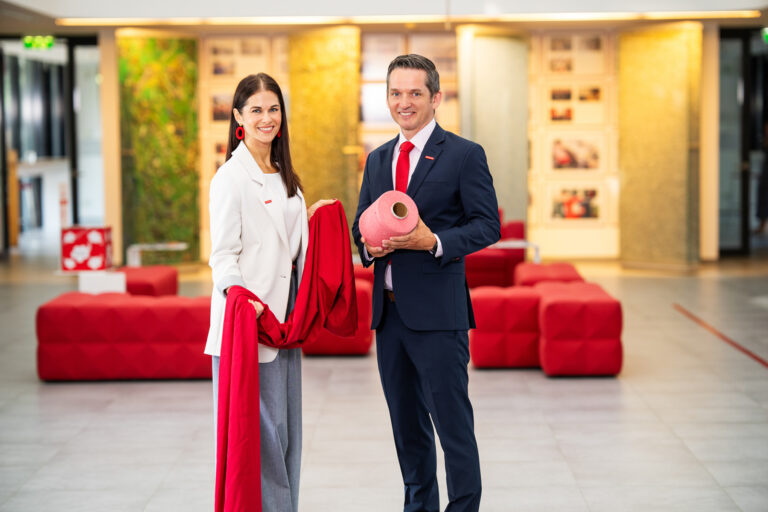
Eva Maria Wurzer, Business Development Textiles Saubermacher; Andreas Opelt, CEO Saubermacher
Where circularity really begins
A discarded garment does not automatically become a new garment. Once it enters a collection system, it must be assessed and sorted, and this is where the process becomes considerably more complicated. Fiber composition, color, condition and contamination can all affect what happens next. A garment that can no longer be worn may still contain valuable material but recovering that value requires detailed sorting than simply separating clothes into wearable and non-wearable piles.
As Eva-Maria Wurzer, Business Development Textiles at Saubermacher, puts it:
“Textile recycling is a team effort. There does not exist a single technology that can turn every piece of used textile back into a new garment.”
The key, she says, is identifying the material correctly and finding the right recycling route for each category. Saubermacher is working on this part of the problem through a growing network of research, technology, collection and recycling partners. Its ReUseTex project is developing automated, AI-supported sorting to distinguish reusable textiles from those suitable for recycling, while other initiatives, including StraTex, are examining ways to improve the sorting and processing of textile waste.
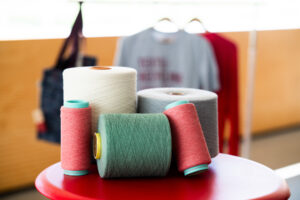
Yarn made out of recycled fibres
The company is also working with Portuguese partner Refibertech to process textile waste into recycled fibers, yarns and fabrics. In the greater Graz area, it is planning a dedicated sorting facility designed to automatically separate non-wearable textiles by material and color.
From waste stream to raw material
The shift is significant because it changes how the end of a garment’s life is viewed. Instead of treating unusable textiles simply as waste, the aim is to identify material that can become a secondary raw material and feed it back into production. But getting there requires investment, infrastructure and, eventually, a market that makes the system viable.
“Our goal is to ensure that as many unusable textiles as possible are sent for material recycling,”
says Andreas Opelt, CEO of Saubermacher. “For that we want to lay the groundwork today and put solutions into practice.”
That groundwork comes with a commercial question. Recycling infrastructure needs investment, while the market for recovered textile materials is still developing. Opelt argues that reliable rules and fair conditions will be necessary if early investment is to develop into a functioning market.
This is an important distinction. The Vienna project is not evidence that textile circularity has already reached industrial scale. It is an example of the infrastructure and partnerships being developed to make greater textile-to-textile recovery possible.
From recovered material to fashion
But recycling is only part of the equation. The recovered material still has to work as a fashion material, and that brings the story back to design. FRÖHLICH and Gabriele Rigby are taking material recovered from the waste stream and bringing it into a fashion context. The aim is not simply to show that old textiles can be processed, but to explore what happens when recovered material has to meet the expectations of fashion: how it looks, feels and performs, and whether designers and consumers will actually want to use and wear it.
That makes the runway more than a showcase. It connects two parts of the circularity conversation that are often discussed separately: what happens to a garment after use, and what happens when that material is brought back into design.
Can the system actually scale?
The Vienna project brings several parts of the chain together: collection, sorting, recovery, fiber processing, fabric development and design. But connecting those stages in one project is very different from making the system work at scale. The accompanying September 18 panel, “Fashion does not end. It begins anew,” will explore what is required to move such initiatives beyond individual projects, with Saubermacher CEO Andreas Opelt, Gabriele Rigby, fair-fashion activist Nunu Kaller and Tércio Pinto of Impetus Group, moderated by
Lilian Klebow.
Because a functioning circular system needs more than recycling technology. It needs reliable collection and accurate sorting, viable markets for secondary raw materials, and designers and manufacturers willing to incorporate them. It also needs an economic model that allows the whole chain to work.
As Wurzer puts it, Saubermacher’s goal is to return “as many textiles as possible to textile applications” rather than treating recycling as a single technological solution. That is the real test. When a garment has reached the end of its first life, can its material have
another?
At Vienna Fashion Week, the runway will show one possible answer. The harder work is building the system that could make that answer viable beyond the catwalk.
All Images Courtesy: Saubermacher/kump.photography
Featured Image: Eva Maria Wurzer, Business Development Textiles Saubermacher; Andreas Opelt, CEO Saubermacher