

Fashion’s sustainability challenge begins long before a garment reaches a shop floor. It begins with the decisions brands make about what to design, which trends to follow and how much to produce. When those decisions are based on incomplete information, the consequences can include unsold inventory, wasted materials and unnecessary production.
Could artificial intelligence help change that equation?
Traditional trend intelligence has often been prohibitively expensive for independent designers and smaller fashion labels, leaving them without access to the structured insights available to larger fashion houses. Yet, in an industry where creative instinct is essential, the challenge is not simply to predict what will sell. It is to understand which emerging trends are relevant to a brand’s identity and its customers, without sacrificing originality.
This is the space BrushCode, founded by Shreya Bhan, is seeking to address. The platform combines trend intelligence with brand-specific insights, helping designers understand their distinctive aesthetic, identify relevant emerging trends and evaluate design concepts before committing to sampling and production.
The sustainability opportunity lies in what better information could make possible: more informed design decisions, greater confidence before production and potentially less reliance on speculative volumes. While technology alone cannot solve fashion’s environmental challenges, it may offer a way to address one of their underlying drivers — uncertainty.
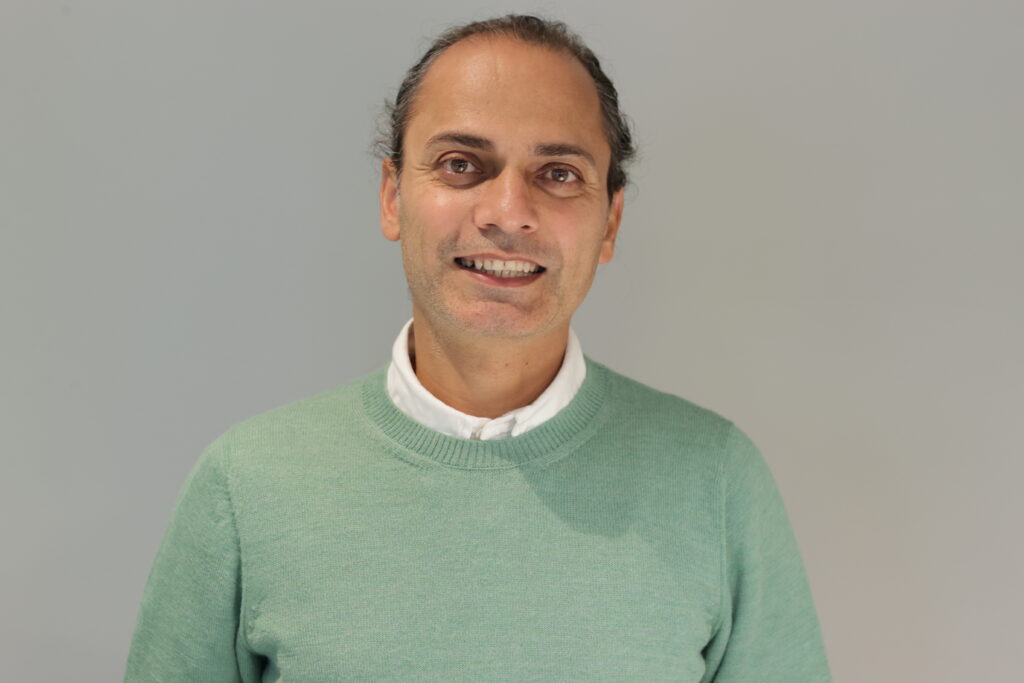
In this conversation with LuxuryNext, Shreya discusses how BrushCode works, why brand identity matters in AI-powered trend forecasting, and how technology could support a more intentional approach to fashion, production and the meaning of luxury itself.
In Conversation with Shreya Bhan, Founder of BrushCode
How does BrushCode work?
SHREYA BHAN: BrushCode works in three connected layers. The first is the intelligence, the platform continuously monitors trend signals across social media, editorial, retail and search, pulling in data from multiple sources and classifying everything using an AI layer that assigns relevance scores and category tags. The second is personalization, every brand using BrushCode has a Brand DNA profile built from their existing collections, aesthetic codes, color preferences and silhouette language. Every trend that enters the system gets scored against that specific profile, so a minimalist label and a maximalist label see completely different recommendations from the same underlying data. The third is validation, designers can test a concept against their brand DNA and current trend momentum before committing to sampling, which means they get a signal on viability before any fabric is cut or money is spent.
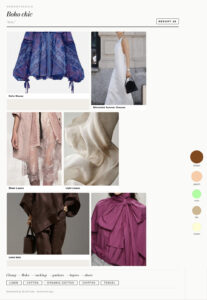
Moodboard, Image Courtesy: BrushCode
What gap did you see in the market?
SHREYA BHAN: I spent fifteen years inside the fashion industry watching the same dynamic play out. The tools that gave brands real trend intelligence, the ones that could tell you not just what was trending but why, and whether it was relevant to your specific customer cost upwards of £15,000 to £20,000 a year. That put them firmly out of reach for the independent labels, the small studios, the designers doing genuinely interesting work without the budget of a major house. They were making decisions based on Instagram scrolling and gut feel, which is not a bad thing, instinct matters enormously in fashion but they were doing it without any of the structured signal that larger brands had access to.
BrushCode was built to close that gap. The same quality of intelligence, at a price point that makes sense for a brand with three people and a strong point of view.
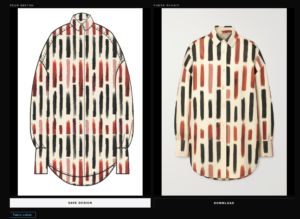
Atelier-Sketch to photo, Image Courtesy: BrushCode
How does BrushCode learn a brand’s DNA?
SHREYA BHAN: The Brand DNA process starts with what a brand has already made. Designers can upload look-books, past collections, campaign imagery and mood references, and the system reads those assets to extract the brand’s visual language, the silhouettes they favor, their color palette, the construction details that recur, the aesthetic codes that define them.
The goal is not to tell a designer what to make. It is to help them quickly identify what is worth paying attention to.
From that, the platform builds a structured profile that it uses to filter and score everything that comes through the trend pipeline. So when a new trend signal arrives, say a particular sleeve proportion appearing across multiple editorial sources, the system asks whether that fits this brand’s specific identity and returns a match score with an explanation. The goal is not to tell a designer what to make. It is to help them quickly identify what is worth paying attention to.
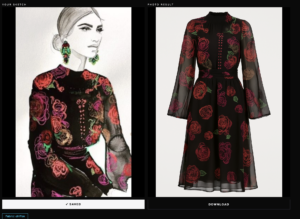
Sketch to photo, Image Credit: BrushCode
How does BrushCode identify emerging trends without undermining creative instinct?
SHREYA BHAN: The system looks for signals that are gaining momentum before they become mainstream, early appearances in niche editorial, emerging on certain communities before they reach mass market, patterns in what specific customer segments are engaging with. But the framing matters.
The tool is meant to inform instinct, not replace it.
BrushCode is not designed to tell a designer what is trending globally and instruct them to follow it. It is designed to surface what is emerging that is relevant to their customer and their brand, which is a very different question. The confidence scores and explanations mean a designer can look at a signal, understand why the system flagged it, and then make their own creative judgment about whether to engage with it, subvert it or ignore it entirely. The tool is meant to inform instinct, not replace it.
How do confidence scores work?
SHREYA BHAN: When BrushCode evaluates a trend against a brand’s DNA, it produces a score that reflects how well that trend aligns with the brand’s established visual identity and how strongly the trend signal is performing across the sources we monitor. A high confidence score means the signal is strong and the alignment is close. A lower score might mean the trend is genuinely emerging but the brand has not historically operated in that territory which could be interesting creatively, or could be a signal to pass.
The score is accompanied by an explanation so the designer understands the reasoning, not just the number. The goal is to make the system legible and trustworthy, not a black box that produces outputs a designer has to accept on faith.
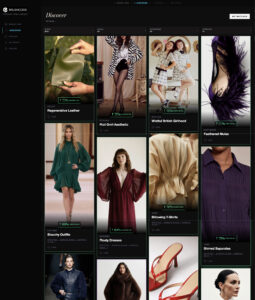
Discover, Image credit: BrushCode
How can better trend intelligence reduce overproduction?
SHREYA BHAN: Most overproduction happens because brands make production decisions without sufficient signal. They forecast based on historical data and intuition, produce to a volume that hedges against uncertainty, and then sit on inventory when the season moves in a different direction than expected.
The real sustainability impact of better design intelligence is not just in what gets made, it is in what does not get made.
Better trend intelligence does not eliminate that uncertainty but it narrows it. If a brand can validate that a direction is gaining momentum with their specific customer before they commit to fabric and production, they can make smaller initial bets with more confidence, and scale what is working rather than producing everything speculatively upfront. The real sustainability impact of better design intelligence is not just in what gets made, it is in what does not get made.
How does BrushCode make sophisticated intelligence accessible?
SHREYA BHAN: Pricing is the obvious answer, a subscription model that makes meaningful trend intelligence available without the enterprise price tag. But accessibility is also a design problem.
The tools that existed were built for trend analysts and buyers at large organizations, people with time and training to interpret complex reports and data visualizations.
Not a report to study but a signal to respond to.
BrushCode is built for a designer who is also running their own business, doing their own marketing and managing their own production. That means the insights have to be specific, explainable and immediately actionable. Not a report to study but a signal to respond to.
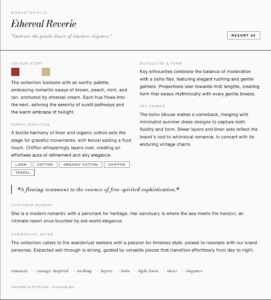
Design Brief, Image credit: BrushCode
How can designers use AI while preserving originality?
SHREYA BHAN: The question assumes a tension that I am not sure is as real as it first appears. A designer who uses a reference library to inform their work does not lose their originality.
The risk is not that AI makes designers less original. The risk is that designers abdicate their judgment to it.
A designer who uses trend intelligence to understand where the market is moving does not lose their voice. AI is another tool in that same lineage, it can accelerate research, surface patterns a human might miss and validate intuitions that would otherwise require expensive testing.
The risk is not that AI makes designers less original. The risk is that designers abdicate their judgment to it, accepting outputs uncritically rather than using them as one input among many. Originality in fashion has always come from a strong point of view applied to real context. AI can improve the quality of the context. The point of view has to come from the designer.
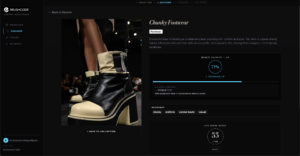
Chunky Footwear concept, Image credit: BrushCode
How do you see AI changing fashion in five years?
SHREYA BHAN: The change is already happening and it is moving upstream fast.
The visible layer right now is imagery, AI-generated campaigns, virtual try-on, synthetic models. But underneath that, AI is entering every stage of how a garment comes to exist. Styling tools are helping brands test creative directions before sampling. AI is generating and validating tech packs, cutting weeks off development cycles. Demand planning tools are giving brands better signal on what to produce before they commit. And micro-factories and made-to-order infrastructure are making the relationship between design and production genuinely flexible for the first time.
The brands that connect these tools into a coherent workflow will have a structural advantage.
The biggest shift over the next five years is when these layers connect. Right now design, production and demand are largely sequential. AI is creating the conditions for them to happen in parallel, with tighter feedback loops at every stage. Brands will test directions against real customer signals before sampling, understand demand before production runs, and make precise decisions about what to make and in what volume.
The sustainability impact follows naturally. Most fashion waste is a consequence of uncertainty. Narrowing that uncertainty changes the economics of production fundamentally. The brands that connect these tools into a coherent workflow will have a structural advantage. We are at the beginning of this, not the middle.
What does true luxury mean to you today?
SHREYA BHAN: Luxury has always been about intention. The time spent on something. The knowledge embedded in it. The decision to do something properly rather than quickly or cheaply. What technology is doing is not threatening that, it is forcing the industry to be clearer about where the intention actually lives. A garment that is beautifully made from responsible materials, designed by someone who genuinely understood their customer, produced in the right quantity rather than speculative volume, that is luxury. The speed and scale that technology enables are only a problem if they are used to avoid the hard creative and ethical decisions rather than to make them better. Used well, AI is an argument for more intentionality in fashion, not less.
All Images credit: BrushCode