
Some of the most interesting ideas in fashion do not begin in Paris, Milan or New York. They can begin much closer to the ground, in places far removed from fashion capitals and global supply chains. Sometimes, they begin with something that has been part of a landscape for generations, waiting for someone to see it differently.
For HimGra, that place is the Himalayas.
“There are no roads.” The woman from the Himalayan village says it matter-of-factly. For her, it is simply part of everyday life. Getting around means walking mountain paths, carrying what is needed and working with what the landscape provides. It is a world that feels very far away from fashion weeks, luxury stores and the global textile industry. And yet, this is where a new textile story is taking shape.
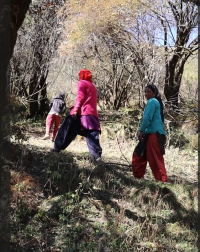
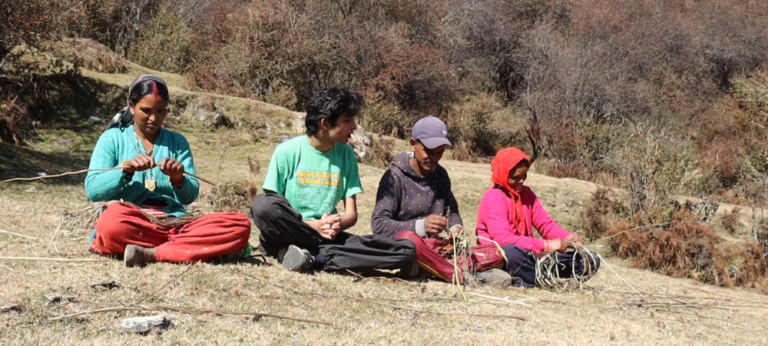
Local women in forest for grass collection
HimGra® is a fiber developed from a naturally occurring Himalayan resource, bringing together a very local material and an industry that is anything but local. Its journey begins in the mountains and is now finding its way into fashion, interiors and other textile applications.
The idea is compelling precisely because it does not begin with the question, What new material can we invent? Instead, it asks: What is already here, and what could it become?
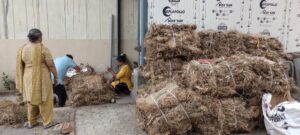
Packing of Yarn
For generations, Himalayan communities have found practical uses for the material, including making ropes, snow footwear and other everyday items. What has changed is the possibility of taking that local resource into a modern textile context.
Turning it into a fiber suitable for contemporary textiles has opened up a new set of possibilities. HimGra can be used in everything from fluid apparel and resort wear to shirts, trousers, jackets and knitwear. It has also found its way into more traditional applications, including sarees, scarves and occasion wear, as well as denim blends. That versatility is what makes it interesting. A new material becomes much more than a sustainability story when designers and textile makers can actually work with it.
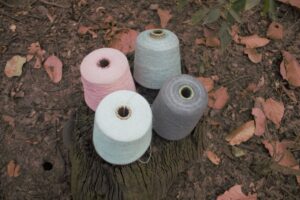
Dyed Yarn
The story does not stop at clothing. HimGra is also being explored for home and interior textiles, including upholstery, curtains, cushions, throws and other soft furnishings. Something rooted in a remote Himalayan landscape is beginning to find a place not only in wardrobes, but also in the spaces around us.
There is another side to the story. In communities where roads and infrastructure can be limited, developing a local resource for a wider market can create opportunities much closer to home. It brings the conversation around materials back to the people and places where those materials originate.
We’re not trying to bring the Himalayas to fashion. We’re trying to make sure that when fashion arrives, it arrives responsibly.
— K. D. Sharma
For LuxuryNext, this matters. The future of luxury materials is not only about discovering something new. It is also about knowing where materials come from, how value is created and who gets to be part of that journey.
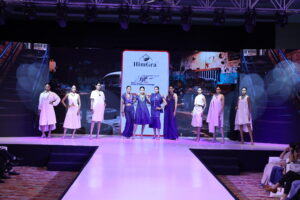
HimGra at CMAI Eco Stitch
HimGra is no longer simply an interesting idea emerging from the mountains. It has received recognition through several innovation and sustainability platforms. It received the CIPS Innovation Award for its work around climate impact, livelihoods and grassroots innovation, and was selected through the HKH Innovation Challenge, supported by ICIMOD and the Global Resilience Partnership. It was also recognised at Bharat Tex 2025, including within the event’s Sustainability Pavilion, and has received support through institutions including the Government of Uttarakhand and IIT Mandi Catalyst.
What happens when a material from a remote Himalayan landscape enters the wider world of fashion? That is the part of the HimGra story still being written.
Its appeal lies in that distance: from mountain paths where there are no roads to designers, textile makers and global brands looking for new materials. For LuxuryNext, HimGra is a reminder that innovation does not always arrive from a laboratory or a fashion capital. Sometimes, it begins by looking at a familiar landscape differently.
And this time, that new perspective is taking a Himalayan resource all the way to fashion.