
What gives luxury its soul?
Much of the conversation around the future of fashion looks at its substance: what things are made of, how they are made and how well they endure. We also look at the systems behind them: where materials come from, how products move through supply chains, and how transparency and accountability are built into the process.
But sometimes we need to look beyond the substance and the systems that create fashion and ask a different question: what gives it a soul?
It can be the hand that made something, the heritage carried in a piece of clothing, the place it comes from, or the person who wears it. It can also be the knowledge, memory and intuitive talent embedded in the work, whether that belongs to a craftsman shaping an object or an artist seeing it in an entirely different way.
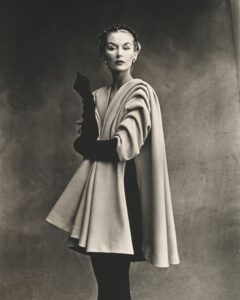
Balenciaga Mantle Coat (Lisa Fonssagrives-Penn)
Few photographers understood this dimension of fashion better than Irving Penn.
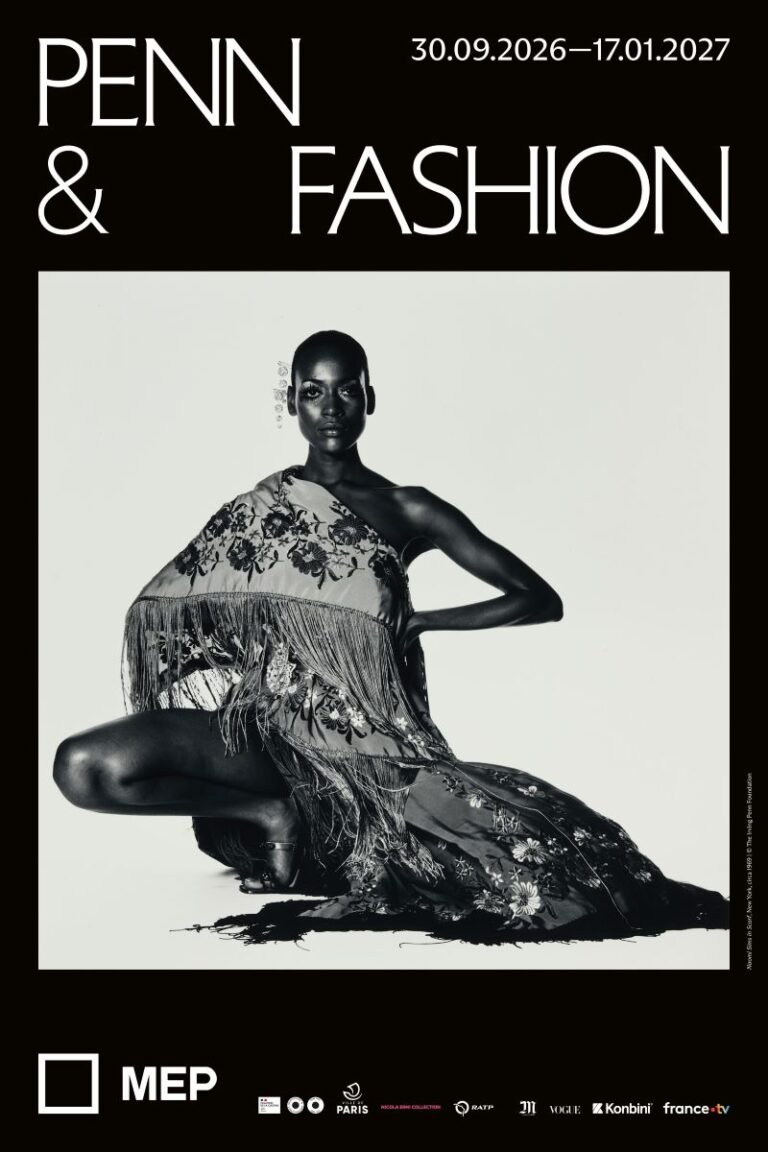
PENN & FASHION
Maison Européenne de la Photographie, Paris
30 September 2026 – 17 January 2027
5/7 rue de Fourcy, 75004 Paris
Presented in collaboration with The Irving Penn Foundation and the Nicola Erni Collection.
At the Maison Européenne de la Photographie, PENN & FASHION brings together more than six decades of Penn’s fashion photography, from 1947 to 2008, tracing a career shaped by an unmistakable eye and a lifelong relationship with Vogue.
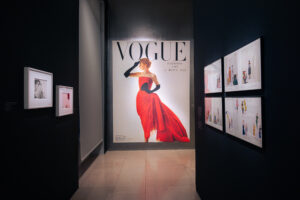
MEP Saison, September 2026, Photograph credit: Quentin Chevrier
For LuxuryNext, this is what makes the exhibition worth looking at: not simply fashion as image, but the stories, people, craftsmanship, culture and creative vision that can sit behind an object, and what happens when a photographer sees all of that and makes us look again.
This is not simply an exhibition about beautiful clothes. It is an exhibition about how a photograph can change the way we look at clothes and reveal something about the culture, craftsmanship and people behind them.
The exhibition begins with work from the late 1940s, including Theatre Accident, a still life from 1947, alongside a Vogue group portrait of some of the most photographed models of the period. From the beginning, Penn was already interested in something beyond simply recording what was in front of his camera.
He was interested in how it could be seen.
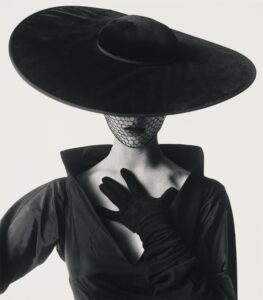
Fashion-Photograph (Jean-Patchett)
From Lima to Cuzco
In 1948, Penn travelled to Lima with Vogue fashion editor Babs Simpson and model Jean Patchett. The resulting fashion story, Flying Down to Lima, was published the following year. After the Vogue team returned to New York, Penn continued travelling.
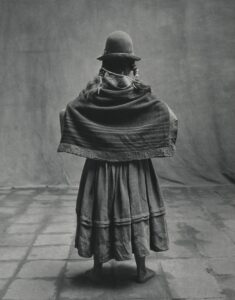
Standing woman with braids, Cuzco, 1948
He then went to Cuzco, the former Inca capital, where he photographed the local Quechua people in their traditional dress. One of the most striking photographs from this period is Standing Woman with Braids, Cuzco, 1948.
The clothes are important, but Penn does not treat them as costume. The neutral setting and quiet pose allow the person, the clothing and the sense of place to remain together. He showed how a garment can carry history, identity, and knowledge of a place.
This became an important part of Penn’s wider work. In later travels through Spain, Nepal, New Guinea and Morocco, he photographed people in traditional dress with the same attention he gave to fashion models. For Penn, the boundary between fashion photography and portraiture was never quite as fixed as it might appear.
Paris, 1950
Two years later, Penn was in Paris photographing haute couture. He worked with designers including Balenciaga, Lafaurie and Rochas, using a studio on Rue de Vaugirard. Lisa Fonssagrives, one of the great models of the period and later Penn’s wife, became an important collaborator.
He chose a deliberately simple setting with was an old theatre curtain as the backdrop, and there was little theatrical staging. The focus remained on the model, the garment, the light and the space around them.
This was the period of post-war couture and the revival of the Paris fashion houses. Dior’s New Look brought a new silhouette; Balenciaga was known for construction and form.
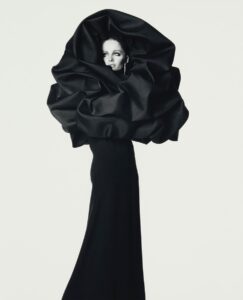
Balenciaga Rose Dress
Penn’s black-and-white photographs made those qualities visible. Fabric became texture in his photographs, a sleeve became shape and the silhouette became almost architectural. His photographs were not simply showing the clothes but were interpreting them in a unique, striking way.
The People Behind the Clothes
Around the same period, Penn was also photographing people who had nothing to do with haute couture. His Small Trades series brought workers, tradespeople, street vendors, artisans and laborer’s into the studio, who he photographed with the same seriousness he gave to famous models.
A worker’s clothing might be worn and practical rather than fashionable, but Penn found something in the way people stood, held their tools and inhabited what they wore.
The photographs are a reminder that clothing is not only about appearance. It is also connected to work, place and daily life. Elegance, in Penn’s photographs, was never reserved just for couture.
Six Decades of Fashion
During the 1960s and 1970s, ready-to-wear grew in importance and the relationship between fashion, the body and society began to change. Penn photographed designers such as Courrèges and Ungaro, as well as models including Marisa Berenson and Lauren Hutton.
The clothes became more experimental. Shapes became sharper, stranger and sometimes more sculptural.
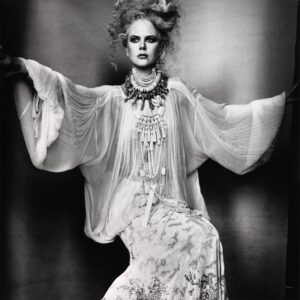
Nicole Kidman in a Jean Paul Gaultier Couture
Later came Yves Saint Laurent, Karl Lagerfeld, Chanel, Christian Lacroix and John Galliano. Color also became more important in Penn’s later fashion work. Rich gowns, feathers and more elaborate silhouettes brought a different quality to his photographs, yet the essential Penn remained. Fashion changed but his way of looking did not.
When Irving Penn Met Issey Miyake
One of the most interesting relationships in the exhibition is Penn’s long collaboration with Issey Miyake, which began in 1986 and continued for thirteen years.
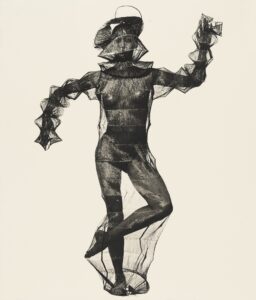
Young-Woman in a Net, Issey Miyake Design
Miyake’s clothes were very different from the couture Penn had photographed in the 1950s. They were sculptural, often built around folds, volume and movement rather than the traditional idea of a fitted silhouette.
Miyake was interested in what fabric could do around the body. Penn was interested in how form, fabric and the body could be seen together.
A Paris Visit Worth Making
If you are visiting Paris this autumn or through January 2027, PENN & FASHION is well worth a visit.
It brings together timeless fashion, from Balenciaga and Dior to Issey Miyake, seen through the lens of a photographer who could strip an image back to its essentials and reveal the beauty and character of the clothes.
Perhaps that is what we mean by Soul: the art, craft and individual eye of the people involved in creation. Penn had that eye. And this exhibition gives us the chance to see it at work.
All images courtesy of Maison Européenne de la Photographie (MEP), Paris.