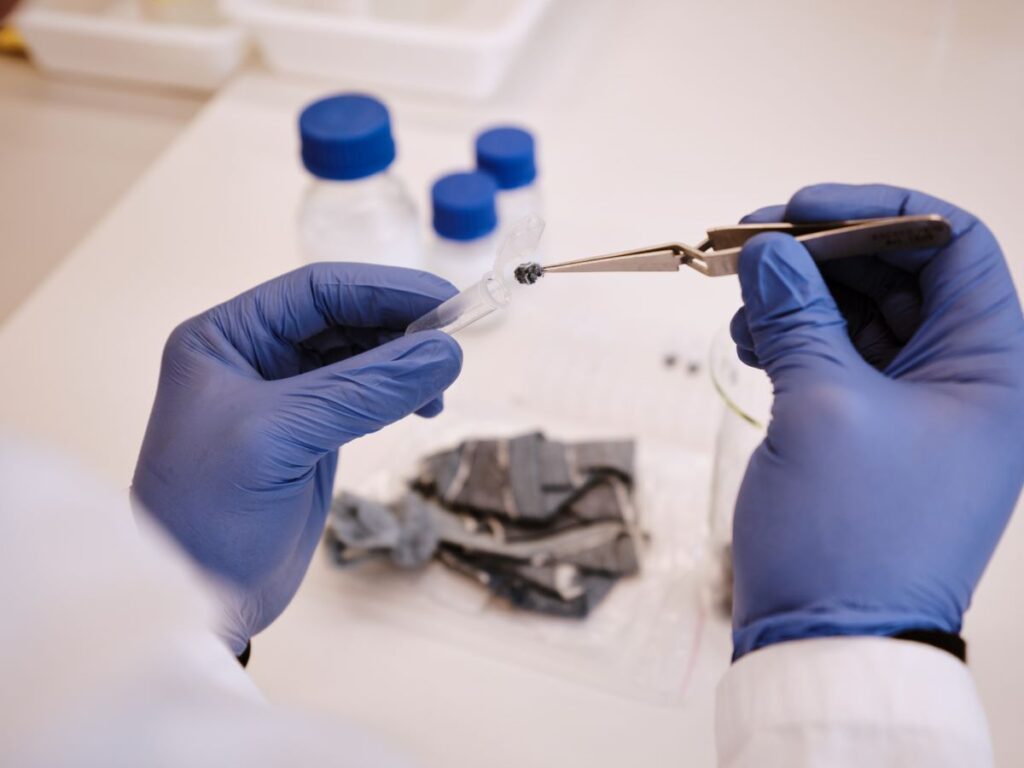

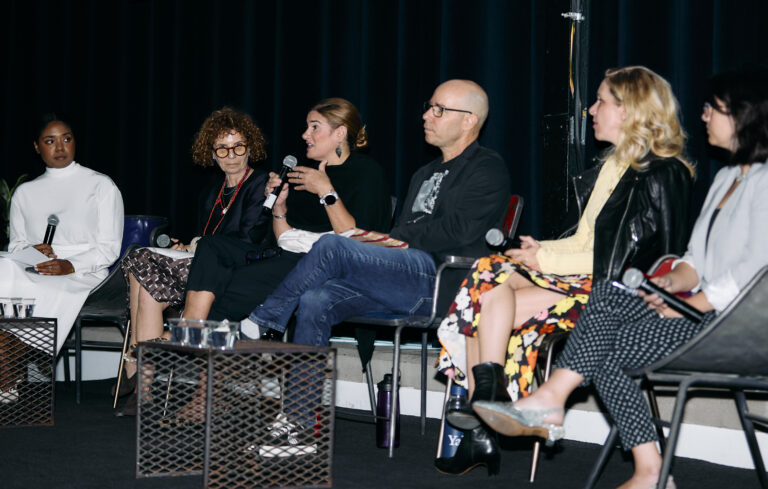
Inside the Sustainable Design Impact Hub’s fourth edition in New York, founders, scientists, investors and fashion leaders came together to look at what it really takes to move new materials from the lab towards the market.
The Sustainable Design Impact Hub is a 501c3 non-profit organization founded by Shannen-Kaylia Henry, a biologist, social entrepreneur and biomaterials start-up founder. She has previously hosted the hub in Biella, Italy and on Small Island Developing States, with context-specific themes that related to the sustainable development of design industries.
A few weeks ago, LuxuryNext looked ahead to the fourth edition of the Sustainable Design Impact Hub and the question behind it: what does it take to move a new material from the lab into fashion?
On September 17, we saw that question explored at Newlab in the Brooklyn Navy Yard during New York Climate Week.
The fourth edition, Fashion × Deep Tech, brought together more than 170 founders, scientists, academics, investors and industry leaders. Founded and curated by biologist, entrepreneur and CocoaFiber founder Shannen-Kaylia Henry, the Hub was shaped in part by her own experience developing a textile fiber from cocoa agricultural waste.
The premise was simple. Developing a new material is only the beginning. For it to reach fashion, it also needs funding, manufacturing, talent, buyers and people who can help move it through the industry.
Left to Right: Ross-McBee, Stephanie Downs, Adam Baruchowitz, Mridu Jhangiani, VictoriaSmith. Photo credit: Mareeka Dookie
Rather than a traditional conference, Shannen created a focused gathering where those different perspectives could meet. Six conversations, an Innovation Gallery, a closed door Pitch Hour and informal exchanges throughout Newlab gave the day a practical focus on what needs to happen next.
Seeing and touching what comes next
At the center was the Innovation Gallery. Shannen-Kaylia imagined a space where next-gen materials were positioned artfully, in a gallery style that provoked real-life, human experience. Jesse Adler, founder of Pitri, joined Innovation to lead its coordination.

Left-to-Right: Shannen-Kaylia, Founder of the hub, Jesse Adler, Founder, Pitri Buuk Innovation Gallery Lead. Photo Credit: Ismail Taylor Kamara
The Gallery featured Biofur, Buuk, CocoaFiber, Coffee Elf, Cornell Fiber Science, Ultrablack, Gyro Plant, Jumbo.nyc, Kickie Chudikova, the Korvaa Consortium by Ourobio, Modern Synthesis and Ecovative, Mela, Modern Meadow and Phlyde.
The work spanned next generation fibers, biomaterials, bio-fabrication, circular systems and new manufacturing approaches.
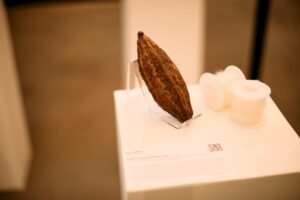
CocoaFiber, regenerated cellulose fiber at the InnovationGallery. Photo Credit: MareekaDookie
What stood out was that these were not simply ideas being presented from a stage. The materials could be seen and touched. Visitors could speak directly with the people developing them and ask about performance, feedstocks, production, scale and possible applications in fashion.
That made the Gallery a natural meeting point. Founders could talk to potential investors, researchers or industry partners, while fashion professionals could encounter materials at a much earlier stage than they might normally see them.
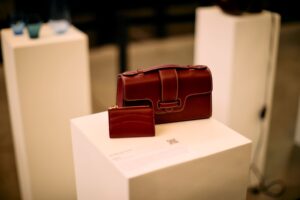
Uncaged Innovations, Elevate Leather, a grain-based bioleather at the InnovationGallery. Photo Credit: MareekaDookie
From the lab to the fashion industry
The day’s program picked up many of the same questions from different sides.
Sessions on building deep tech in New York, educating for the next generation of materials, and Inside Fashion Houses, co-moderated by Jessica Binns of Vogue Business and Jessica Kwon of The Business of Fashion, looked at the people, skills and industry structures needed to support new materials.
The Resources for Building Deep Tech in NYC session, moderated by Jesse Henry of ALT LABS and Heartland Biomaterials, looked at research facilities, laboratory access and finance.
One of the most practical discussions was The Procurement Problem: Getting Next Generation Materials to Market, presented with Lonely Whale and moderated by CEO Adam Bent, with Dr. Theanne Schiros, Vanessa Barboni Hallik and Dana Davis.
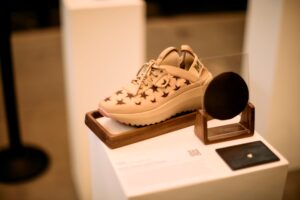
Plhyde, circular plant leather at the Innovation Gallery. Photo Credit: Mareeka Dookie
The question was one many material innovators eventually face: even when a brand is interested and the science works, how does a new material actually make it through procurement and into production?
The program closed with The Next 140 Years of Innovation, bringing together Martin Sauber of Mercedes Benz Research & Development North America and Jack Feldman of Modern Meadow, moderated by Shannen, to look at how established companies and emerging businesses can work together around new technologies.
Making the right connections
The Hub also included a closed door Pitch Hour, where emerging companies had three minutes to present their work to a small group from venture capital, banking, intellectual property, academia, industry and innovation organizations.
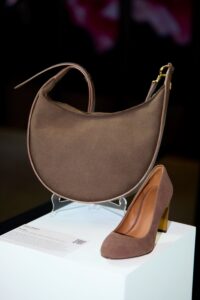
Modern Meadow, Innovera: a bio based leather alternative, at the Innovation Gallery. Image Credit: MareekaDookie
There was no traditional competition or single winner. The idea was to create useful introductions and give founders access to people who might help with funding, research, manufacturing or industry connections.
That approach ran through the event as a whole. It was less about gathering the largest possible audience and more about creating the right setting for people who normally sit in different parts of the innovation process to meet.
The materials themselves helped start those conversations.
A much bigger conversation than fashion
The range of participants reflected how much wider the materials discussion has become.
Mercedes Benz Research & Development North America joined as Innovation Partner, alongside Western Alliance Bank Innovation Banking Group, Lonely Whale, ESSPO, Just Ice Tea and BjornQorn. Academic participation included the Fashion Institute of Technology, the Advanced Science Research Center at CUNY and the Yale Center for Business and the Environment.
Together, they brought science, finance, research, manufacturing, technology and fashion into the same discussion.
For Shannen-Kaylia, that was the real purpose of the Hub.
The outcome of the Hub was exactly what I hoped for: people who sit at completely different points in the innovation journey were suddenly in the same room. Scientists were speaking with fashion leaders, founders were meeting investors and industry, and emerging materials were being experienced beyond the lab. We didn’t set out to simply talk about the future of materials; we wanted to create the relationships and infrastructure that can actually help build it.
A new material does not move from laboratory to production on its own. It needs people who understand the science, the business, the manufacturing and the realities of fashion to find a way forward together.
The Hub created a place for some of those conversations to begin.
From New York to Paris
The Sustainable Design Impact Hub will take this work to Paris during Haute Couture Week, continuing its focus on materials, innovation and the relationships needed to move ideas forward.
The New York gathering offered a useful glimpse of where sustainable and regenerative materials are heading. The future will depend not only on scientific breakthroughs, but on what happens when science meets design, capital, manufacturing and procurement.
Sometimes, the first step is simply bringing those people, and the material itself, into the same room to generate ideas about what comes next.