
Founded in 2011, Lagos Fashion Week began as a project of passion, dedication and vision: a platform for African designers, but also a way of reconnecting fashion with the people, cultures, materials and traditions from which it came. Over time, that vision has grown into an ecosystem where designers, artisans, heritage, land, materials and contemporary fashion meet.
For fifteen years, Omoyemi Akerele has been building something in Lagos that is considerably bigger than a fashion week.

Image Courtesy: Lagos Fashion Week
That connection can be seen in the designers who have emerged through its ecosystem. Adebayo Oke-Lawal of Orange Culture has used fashion to explore identity and fluidity. Lisa Folawiyo has reinterpreted the bold wax-print textiles widely known as Ankara, turning them into a contemporary design language with international reach. Bubu Ogisi of I.AM.ISIGO approaches textiles as cultural memory and material knowledge, while designers working through Lagos Fashion Week continue to draw on local crafts, materials and techniques that connect contemporary fashion to generations of knowledge.
It is not one aesthetic or one definition of African fashion. It is an ecosystem in which people, place, culture and creative practice inform one another.
That is important because sustainability has increasingly become part of this story. Lagos Fashion Week has developed initiatives that encourage designers to work with waste, rethink materials, strengthen local supply chains and reconnect contemporary fashion with knowledge that already exists within communities.
By its 15th anniversary, Lagos Fashion Week had become much more than a runway event. It had become a platform capable of influencing how fashion is made, presented and understood. That was the work the Earthshot Prize recognized.
Why Lagos Fashion Week won the Earthshot Prize
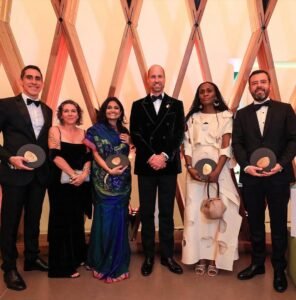
Lagos Fashion Week founder Omoyemi Akerele pictured alongside fellow Earthshot Prize winners and HRH Prince William at The Earthshot Prize Awards, 2025, Photo credit: The Earthshot Prize
In November 2025, at The Earthshot Prize awards in Rio de Janeiro, Lagos Fashion Week was named the winner of the Build a Waste-Free World Earthshot.
Founded by HRH Prince William, The Earthshot Prize identifies solutions to some of the world’s most urgent environmental challenges, with each winner receiving £1 million to help advance or scale its work.
Lagos Fashion Week won because it was demonstrating that fashion could address waste at the level of an entire ecosystem rather than through isolated products or collections.
Its approach includes sustainability standards for participating designers, covering areas such as material sourcing, dyeing, production and transportation, alongside efforts to strengthen local supply chains, revive craftsmanship and turn waste into value.
The Earthshot Prize was therefore not simply rewarding a sustainable collection. It was recognizing a fashion platform attempting to influence the wider system around fashion.
And the £1 million prize offered something more important than visibility: the possibility of taking that work further.
From Earthshot recognition to the African Fashion Coalition
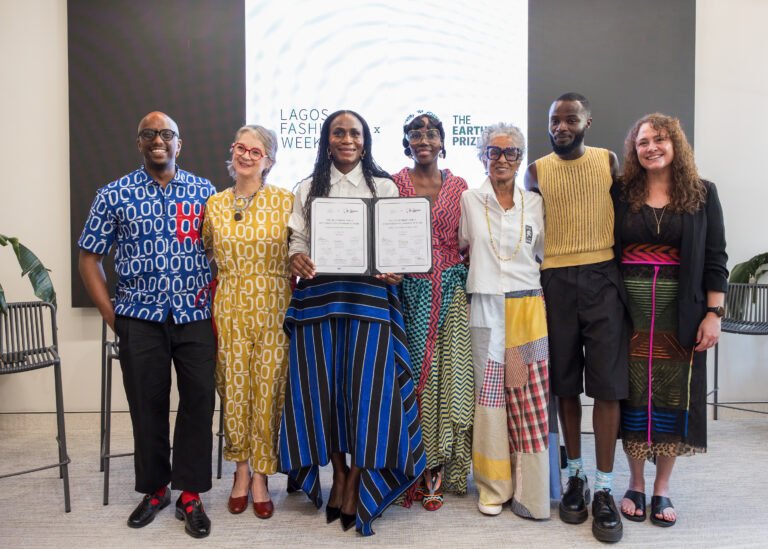
The Earthshot Prize created momentum. The next step was to turn that recognition into a broader collective vision. That came in June 2026, during London Climate Action Week, when the African Fashion Coalition introduced the Blueprint for a Regenerative Fashion Future.
The initiative brought together voices including Omoyemi Akerele, Adama Paris, Mahlet Teklemariam, Sammy Oteng, Renee Neblett, Jackie May and Sunny Dolat, among others working across fashion, culture, sustainability and policy.
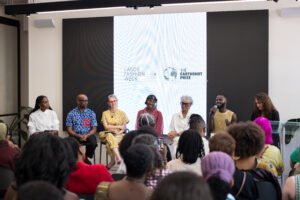
The African Fashion Coalition Team at the London Climate Action Week 2026, Image Courtesy: Lagos Fashion Week
The Blueprint brings together ideas that have long existed within African communities into a shared framework for the future of fashion. Its ten principles address areas including cultural heritage, circularity, community-led creation, intellectual property, waste, local production, innovation, market access and infrastructure.
This is where the Earthshot story becomes something larger.
The Prize recognized what Lagos Fashion Week had built. The Blueprint asks what can be built next.
Regeneration in its truest sense
The word regenerative is now everywhere in fashion. But the Blueprint gives it a more grounded meaning.
Many practices associated with regeneration already exist across African communities: repairing and reusing, working with local materials, producing closer to where materials are sourced and passing knowledge between generations. So regeneration is not necessarily about inventing something new.
The Blueprint asks fashion to look beyond the finished garment and recognize the people, traditions, knowledge and places that make it possible.
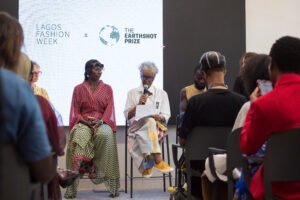
Image Courtesy: Lagos Fashion Week
Who owns the value created by fashion?
Africa has no shortage of creative talent, natural resources, textile traditions or craft knowledge. The harder question is what happens to those resources as they move through the global fashion system.
For luxury, this matters enormously. Luxury has always placed value on provenance, craftsmanship, rarity and heritage. But if provenance creates value, then the people, places, traditions and knowledge behind that provenance should have a meaningful place in the value equation too.
That is perhaps the deeper idea behind the Blueprint: regeneration is not only about restoring ecosystems, but about reshaping who creates, owns and benefits from value.
What happens next?
The test now is no longer conceptual. It is about what the Blueprint can actually set in motion.
Could a framework that has emerged from African fashion offer a model for other regions with deep traditions of craftsmanship, cultural knowledge and material heritage?
The framework gives designers, fashion weeks, investors, governments and global brands a common starting point. It could help strengthen local production, protect cultural and intellectual property, support the communities behind traditional knowledge and keep more value where fashion is actually created.
And perhaps this is where the story gets even more interesting. Could a framework that has emerged from African fashion offer a model for other regions with deep traditions of craftsmanship, cultural knowledge and material heritage?
India is one obvious example. It has centuries-old traditions of handloom, natural fibers, indigenous dyeing and craft. Other parts of Asia and Latin America have their own equally rich systems of knowledge. The point would not be to copy the Lagos model, but to see what happens when different fashion ecosystems build on their own cultural and ecological foundations.
Lagos Fashion Week spent fifteen years building an ecosystem before the Earthshot Prize amplified its global reach. The African Fashion Coalition has now taken that momentum further, giving it greater depth, meaning and a framework for action.
Now comes the interesting part. Where does that framework go next, and what might other fashion cultures build from it?
All Images Courtesy: Lagos Fashion Week
LuxuryNext first examined the African Fashion Coalition’s Blueprint in June 2026, exploring what its principles could mean for global sourcing. Read our earlier analysis: The New African Fashion Manifesto: What the Earthshot-Backed Blueprint Means for Global Sourcing.