
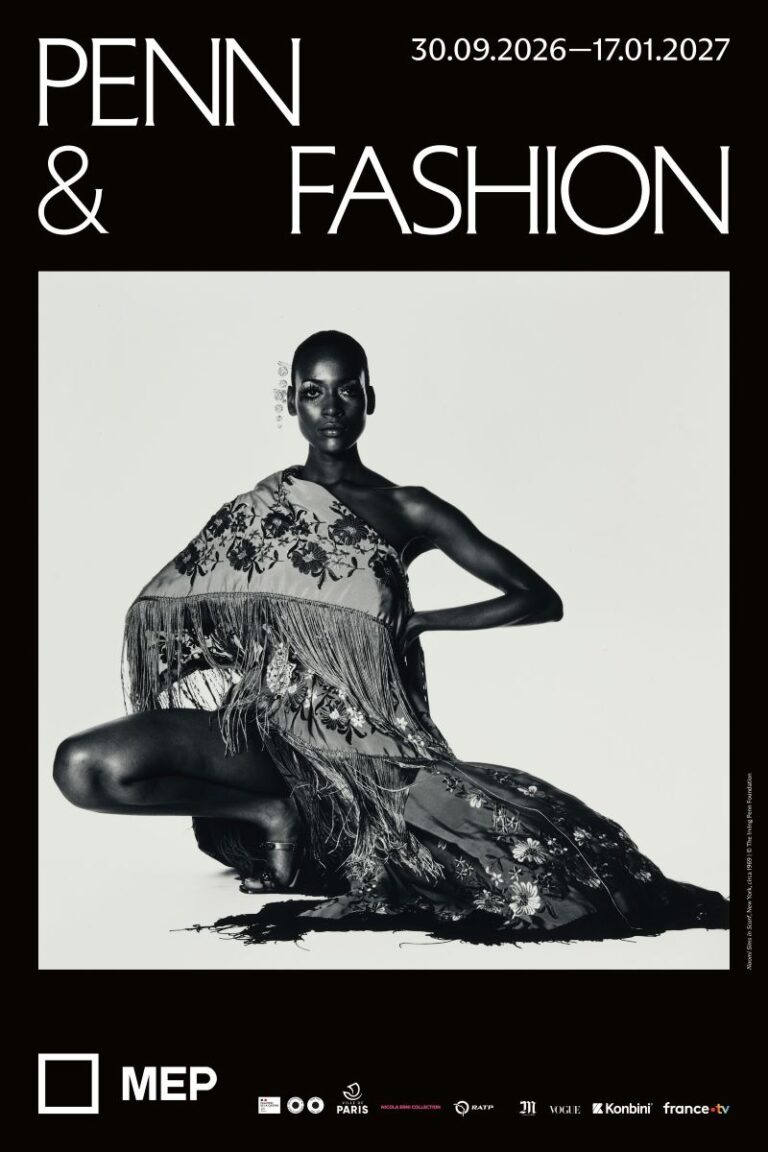
Irving Penn, Naomi Sims in Scarf, New York, circa 1969
Collection The Irving Penn Foundation, New York
© The Irving Penn Foundation
What happens when some of the greatest names in fashion meet one of the greatest eyes behind the camera?
From Dior’s iconic silhouettes and Balenciaga’s sculptural creations to the innovative forms of Issey Miyake, Irving Penn spent more than six decades capturing fashion in a way few photographers could. His photographs were elegant but never merely decorative. With a spare backdrop, careful lighting and an extraordinary eye for detail, he could make a garment’s shape, texture and character speak for themselves.
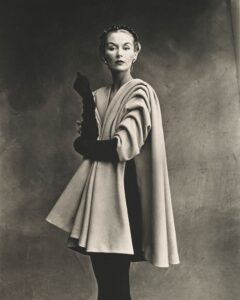
Irving Penn, Balenciaga Mantle Coat (Lisa Fonssagrives-Penn), Paris, 1950
Collection MEP, Paris. Acquis en 1992.
© Condé Nast
This autumn, Paris offers a chance to revisit that remarkable body of work through PENN & FASHION, an exhibition at the Maison Européenne de la Photographie. Spanning 1947 to 2008, it follows Penn’s evolving relationship with fashion, from post-war haute couture to some of the most distinctive designers of the late twentieth century.
PENN & FASHION
Maison Européenne de la Photographie, Paris
30 September 2026 – 17 January 2027
5/7 rue de Fourcy, 75004 Paris
Presented in collaboration with The Irving Penn Foundation and the Nicola Erni Collection.
But this is more than a showcase of beautiful clothes. Penn had a rare ability to reveal what made each image distinctive: the character of the person, the ingenuity of the design and the vision of the people who brought it to life. That is part of what makes his work endure and why this exhibition is worth seeing.
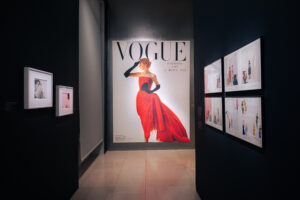
MEP Saison, September 2026, Photograph credit: Quentin Chevrier
This is not simply an exhibition about beautiful clothes. It is an exhibition about how a photograph can change the way we look at clothes and reveal something about the culture, craftsmanship and people behind them.
The exhibition begins with work from the late 1940s, including Theatre Accident, a still life from 1947, alongside a Vogue group portrait of some of the most photographed models of the period. From the beginning, Penn was already interested in something beyond simply recording what was in front of his camera.
He was interested in how it could be seen.
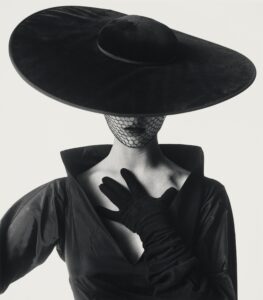
Irving Penn, Fashion Photograph (Jean Patchett), New York, 1949
Nicola Erni Collection, Zug
© The Irving Penn Foundation
From Lima to Cuzco
In 1948, Penn travelled to Lima with Vogue fashion editor Babs Simpson and model Jean Patchett. The resulting fashion story, Flying Down to Lima, was published the following year. After the Vogue team returned to New York, Penn continued travelling.
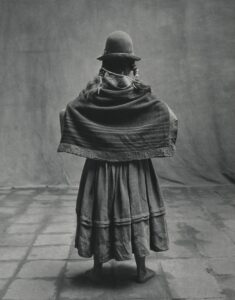
Irving Penn, Standing Woman with Braids, Cuzco, 1948
Collection de The Irving Penn Foundation, New York
© The Irving Penn Foundation
He then went to Cuzco, the former Inca capital, where he photographed the local Quechua people in their traditional dress. One of the most striking photographs from this period is Standing Woman with Braids, Cuzco, 1948.
The clothes are important, but Penn does not treat them as costume. The neutral setting and quiet pose allow the person, the clothing and the sense of place to remain together. He showed how a garment can carry history, identity, and knowledge of a place.
This became an important part of Penn’s wider work. In later travels through Spain, Nepal, New Guinea and Morocco, he photographed people in traditional dress with the same attention he gave to fashion models. For Penn, the boundary between fashion photography and portraiture was never quite as fixed as it might appear.
Paris, 1950
Two years later, Penn was in Paris photographing haute couture. He worked with designers including Balenciaga, Lafaurie and Rochas, using a studio on Rue de Vaugirard. Lisa Fonssagrives, one of the great models of the period and later Penn’s wife, became an important collaborator.
He chose a deliberately simple setting with was an old theatre curtain as the backdrop, and there was little theatrical staging. The focus remained on the model, the garment, the light and the space around them.
This was the period of post-war couture and the revival of the Paris fashion houses. Dior’s New Look brought a new silhouette; Balenciaga was known for construction and form.
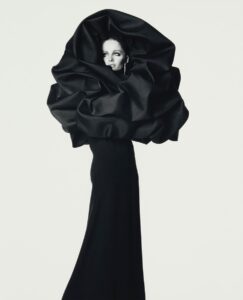
Irving Penn, Balenciaga Rose Dress, Paris, 1967
Nicola Erni Collection, Zug © Condé Nast
Penn’s black-and-white photographs made those qualities visible. Fabric became texture in his photographs, a sleeve became shape and the silhouette became almost architectural. His photographs were not simply showing the clothes but were interpreting them in a unique, striking way.
The People Behind the Clothes
Around the same period, Penn was also photographing people who had nothing to do with haute couture. His Small Trades series brought workers, tradespeople, street vendors, artisans and laborer’s into the studio, who he photographed with the same seriousness he gave to famous models.
A worker’s clothing might be worn and practical rather than fashionable, but Penn found something in the way people stood, held their tools and inhabited what they wore.
The photographs are a reminder that clothing is not only about appearance. It is also connected to work, place and daily life. Elegance, in Penn’s photographs, was never reserved just for couture.
Six Decades of Fashion
During the 1960s and 1970s, ready-to-wear grew in importance and the relationship between fashion, the body and society began to change. Penn photographed designers such as Courrèges and Ungaro, as well as models including Marisa Berenson and Lauren Hutton.
The clothes became more experimental. Shapes became sharper, stranger and sometimes more sculptural.
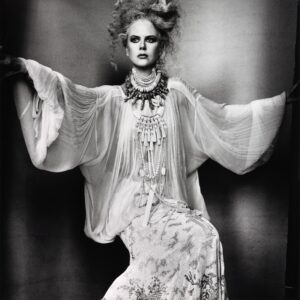
Irving Penn, Jean Paul Gaultier Couture (Nicole Kidman), New York, 2004
Nicola Erni Collection, Zug
© Condé Nast
Later came Yves Saint Laurent, Karl Lagerfeld, Chanel, Christian Lacroix and John Galliano. Color also became more important in Penn’s later fashion work. Rich gowns, feathers and more elaborate silhouettes brought a different quality to his photographs, yet the essential Penn remained. Fashion changed but his way of looking did not.
When Irving Penn Met Issey Miyake
One of the most interesting relationships in the exhibition is Penn’s long collaboration with Issey Miyake, which began in 1986 and continued for thirteen years.
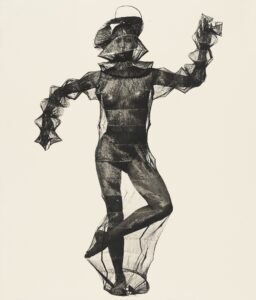
Irving Penn, Young Woman in a Net (Miyake Design), New York, 1993
Collection MEP, Paris. Acquisition ayant bénéficié du soutien de
The Irving Penn Foundation en 2020
© The Irving Penn Foundation
Miyake’s clothes were very different from the couture Penn had photographed in the 1950s. They were sculptural, often built around folds, volume and movement rather than the traditional idea of a fitted silhouette.
Miyake was interested in what fabric could do around the body. Penn was interested in how form, fabric and the body could be seen together.
A Paris Exhibition to See This Season
Visiting Paris between now and 17 January 2027? Make time for PENN & FASHION.
From Balenciaga and Dior to Issey Miyake, the exhibition brings timeless fashion into focus through Irving Penn’s extraordinary black-and-white photography. His eye captured not just the beauty of a garment, but the creative vision and craftsmanship that gave it character.
This is Soul: the art, skill and individual vision that make creation meaningful. Penn knew how to bring it into view.