
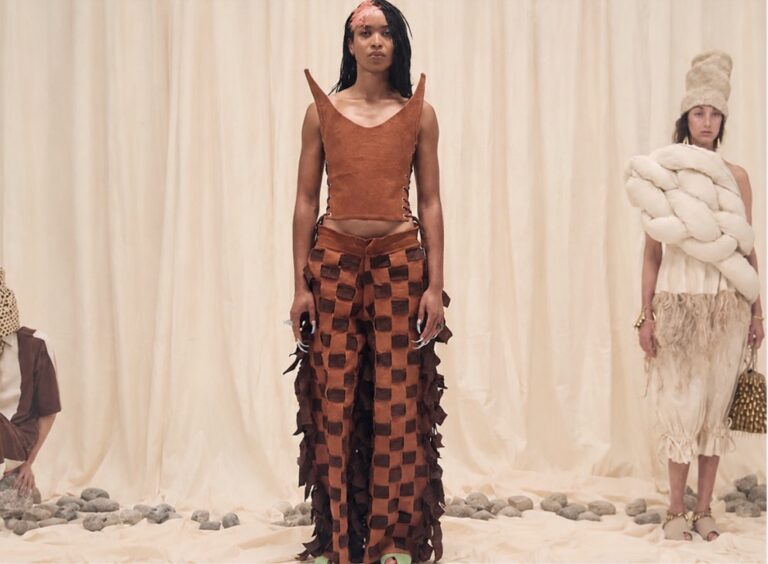
At Copenhagen Fashion Week SS27, Nigerian designer Bubu Ogisi brought together plant based fibers, reclaimed materials and cultural knowledge in her latest collection for I.AM.ISIGO.
What happens when we look at fashion through our relationship with the land?
That question sits at the heart of I.AM.ISIGO’s Spring/Summer 2027 collection, Sacred Ecologies. Presented in Copenhagen on August 6, the collection continues Ogisi’s exploration of ancestral textile knowledge and the relationship between the human body and its environment.
But Sacred Ecologies is about more than natural and recycled materials. It looks at how cultural knowledge is carried forward, how materials connect us to place, and what older ways of understanding the natural world might offer contemporary design.
International Recognition
Ogisi’s approach has also received international recognition. I.AM.ISIGO won the Zalando Visionary Award in 2025, recognizing its work across design innovation, ethical craftsmanship and social impact.
The award praised the brand for preserving ancestral African textile techniques and turning them into modern wearable art. It also recognized their focus on sustainability through natural fibers, upcycling, and circular practices. Additionally, it highlighted their work with African artisans to keep traditional skills alive while creating new economic opportunities.
The recognition sits naturally alongside I.AM.ISIGO’s nomination as a 2026 LVMH Prize semi-finalist, reflecting the growing international attention around Ogisi’s approach to material research, heritage and contemporary African design.
The Power of the Land
One of the collection’s main references is Kenyan writer Ngugi wa Thiong’o’s Wizard of the Crow, a novel that explores power, colonialism and environmental destruction.
Wherever we live, the land around us influences what we grow, what we make, what we inherit and what we pass on.
For Ogisi, these ideas are connected. Environmental questions cannot always be separated from questions about people, land and power. This makes the collection’s idea of ecology broader than simply protecting nature. It looks at the relationship between the environment and the communities that depend on it.
It is also a universal question. Wherever we live, the land around us influences what we grow, what we make, what we inherit and what we pass on.
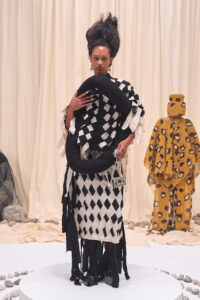
Materials That Carry Their Origins
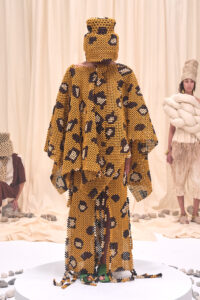
The collection is built almost entirely from plant based and reclaimed materials: banana fiber from Uganda, cotton and wooden beads from Nigeria, sisal from Tanzania, recycled aluminum from Kenya, recycled glass, natural dyes and other reclaimed fibers. The weaving is carried out in Kenya.
For I.AM.ISIGO, craft is not a decorative finish added at the end. It is part of the design process itself.
These materials are not simply anonymous inputs into a production system. They have geographical origins, particular skills associated with them and people who work with them.
The collection also keeps waste within the making process.
Yarn left on the weaving machine is worked back into crochet pieces, while fabric offcuts are returned to outerwear as textured surfaces. The evidence of making remains visible. For I.AM.ISIGO, craft is not a decorative finish added at the end. It is part of the design process itself.
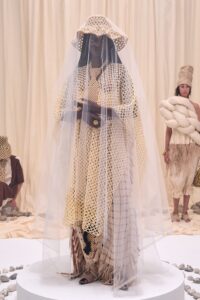
Clothing as Cultural Memory
The collection also draws on the lukasa, a traditional memory board used by the Luba people of Central Africa, particularly in present day Democratic Republic of Congo.
Here, memory means cultural memory: histories, knowledge, places and traditions carried from one generation to another, rather than personal memories or nostalgia.
A lukasa is made from wood and decorated with beads, shells and other materials. It can hold information about genealogy, migration, important places and sacred knowledge.
Its stories are not written down like a book. They are held in the object and understood through the knowledge of the people who use it.
The clothes become carriers of history and knowledge, communicating through material and form rather than words.
Ogisi translates this idea into sculptural pieces that sit somewhere between clothing and object. Their shapes have their own structure rather than simply following the body. The clothes become carriers of history and knowledge, communicating through material and form rather than words.
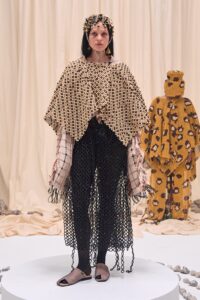
It is a deeply human idea. Across cultures, people have always used objects to hold stories. Jewelry, photographs, buildings, family heirlooms and clothing can all carry meaning long after their makers are gone.
Knowledge That Travels
I.AM.ISIGO also explores how knowledge travels through people, communities, makers and teachers, rather than only through formal institutions.
As the industry searches for new materials and more responsible ways of making, could some of the answers also come from knowledge that already exists?
Skills can be passed from one generation to another through practice: how to work a fiber, recognize a plant, weave a pattern or understand a particular landscape.
For fashion, this raises an interesting possibility. As the industry searches for new materials and more responsible ways of making, could some of the answers also come from knowledge that already exists? The challenge is not simply to preserve these practices as they are, but to allow them to evolve and find new relevance in contemporary design.
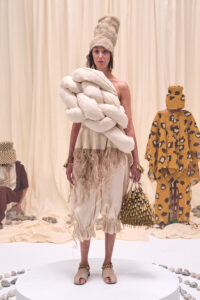
Rethinking Regeneration
This is where Sacred Ecologies connects with the wider conversation around regenerative fashion.
I.AM.ISIGO suggests that looking towards the future does not necessarily mean leaving the past behind. It can mean understanding what existing knowledge can offer and allowing it to develop in new ways.
Regeneration is often discussed through agriculture, fibers, supply chains and environmental impact. But there is another layer: the knowledge, relationships and communities behind those systems.
I.AM.ISIGO suggests that looking towards the future does not necessarily mean leaving the past behind. It can mean understanding what existing knowledge can offer and allowing it to develop in new ways.
The Copenhagen presentation also included an Adidas deconstruction table, with selected pieces from the deconstruction process incorporated into the presentation.