

“We had to rebuild the whole ecosystem from the seed upwards.”
Nishanth Chopra, Founder, Oshadi
Much of fashion’s sustainability conversation begins with the finished garment. Oshadi begins much earlier.
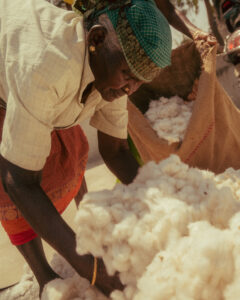
Founded on a seed-to-sew philosophy, the company works directly with farmers to rebuild soil health, grow regenerative cotton and create textiles that remain connected to the land from which they originate. From farming and spinning to weaving and natural dyeing, each stage is designed to strengthen the relationship between nature, craft and fashion.
Today, Oshadi’s regenerative fibers and textiles are used by international designers and brands seeking materials with greater environmental integrity. Yet, as Nishanth Chopra explains, regeneration is not a certification or a marketing claim. It is a long-term commitment that requires patience, investment and a willingness to work with nature rather than against it.
In this conversation with LuxuryNext, Nishanth reflects on rebuilding degraded farmland, working alongside farming communities, balancing fashion’s fast-moving calendars with nature’s slower rhythms, and why rebuilding fashion may have to begin with rebuilding the soil.

Q1. What was the exact turning point that made you realize you needed to control the entire ecosystem from the soil up?
Nishanth Chopra: The turning point came from realizing that most of the sustainability conversations in fashion begin too late. They often start at the garment stage, or sometimes at the fabric stage, but by then many of the most important decisions have already been made. I felt that if we wanted to make clothing in a truly responsible way, we could not only look at the finished product. We had to understand and rebuild the whole ecosystem from the seed upwards.
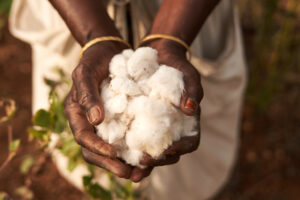
That is what led to Oshadi’s seed-to-sew approach. It was not simply about traceability as a marketing tool. It was about reconnecting all the parts of the system that fashion had separated.
A big part of this was also understanding that it was not enough to simply “source” regenerative cotton or work with farmers at a distance. We needed to be directly involved in the farming itself. Today, our work with farmers is much more hands-on, farmers provide the land, water and weeding support, while we directly manage the inputs, application, crop planning, labour coordination, harvest and post-harvest handling. This allows us to understand the nuances of the process from the ground up, rather than relying only on claims made further down the supply chain.
Q2. What were the primary ecological hurdles in bringing degraded agricultural land back to life in Erode?
Nishanth Chopra: One of the biggest challenges was restoring life to soil that had become used to extractive farming methods. In many cotton-growing regions, land has been pushed very hard through monocropping, chemical inputs and the loss of biodiversity. Soil becomes less alive, water retention reduces, and farmers become dependent on external inputs.
“Regeneration requires patience because soil has memory.”
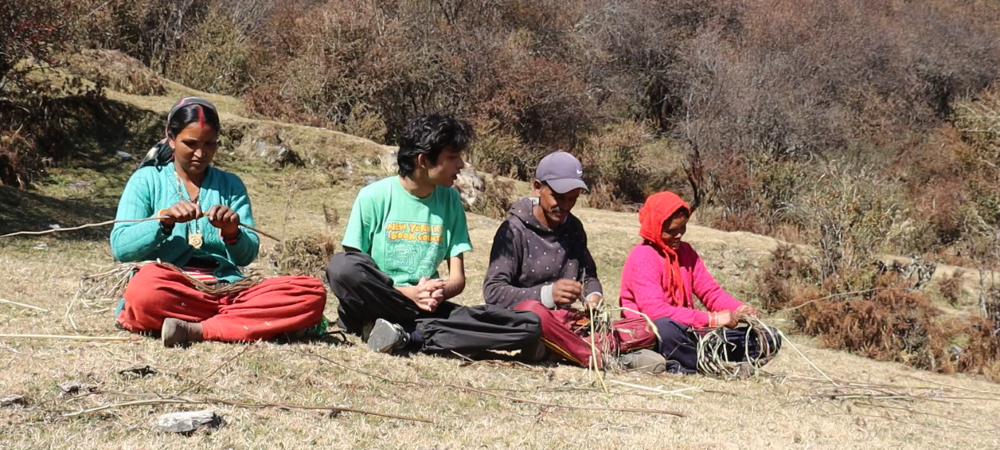
In Erode, the work has been about slowly rebuilding that biological life. This means improving soil organic matter, bringing back composting, encouraging mixed cropping, reducing chemical dependency, and creating a farm ecosystem where cotton can grow alongside food crops, insects, birds, animals and other forms of life.
It is not an overnight transformation. Regeneration requires patience because soil has memory. You cannot simply change one input and expect the whole system to recover immediately. It takes seasons of observation, correction and trust-building with the land and with the farming community.
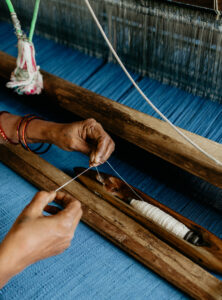
Q3. Sourcing, spinning, natural dyeing, and weaving within a localized radius is complex. What is your biggest daily operational challenge?
Nishanth Chopra: The biggest daily challenge is coordination without compromising the integrity of the process. The farming itself has many daily nuances. We are not only “sourcing” cotton once it is ready; we are involved from the beginning of the crop cycle. That means deciding what inputs to use, when and how they should be applied, coordinating labor, monitoring the crop, managing harvest timing, and dealing with all the practical realities of land, weather, water, pests, weeds and availability of people. Farmers bring their land, water, knowledge and weeding support, and we take responsibility for much of the crop management and regenerative input system. This makes the work much deeper, but also much more complex.
We are trying to build a slower, more responsible system while still operating in a fashion market.
In a conventional supply chain, speed and standardization are often the priority. In our system, we have to balance consistency with the natural character of the material. That requires constant communication between farmers, spinners, weavers, dyers, pattern cutters and the garment team.
The challenge is not only technical. It is also cultural. We are trying to build a slower, more responsible system while still operating in a fashion market that expects speed, precision and delivery dates.
Q4. What is your biggest roadblock in convincing premium international designers to adapt to the slower timelines of natural crop cycles?
Nishanth Chopra: The biggest roadblock is that fashion timelines are still built around the market, not around nature. Designers and brands are often interested in regenerative materials, natural dyes and craft processes, but their calendars are usually very tight. They are used to ordering a fabric and expecting it to behave like an industrial product that can be produced instantly, in any color, at any time.
The slower timeline is not a limitation, but part of the value of the work.
With natural fibers, regenerative cotton and plant-based dyeing, the process asks for a different mindset. Cotton has a growing cycle. Natural dyes have variation. Hand processes require time. The beauty of the material comes from this relationship with season, place and hand.
So the challenge is not only persuading designers to use a different material. It is helping them adapt their design and production process to a different rhythm. The most meaningful collaborations happen when the designer understands that the slower timeline is not a limitation, but part of the value of the work.
Q5. With so many legacy brands using “regenerative” as a vague marketing buzzword, how does Oshadi provide hard data to prove supply chain integrity?

Nishanth Chopra: Regenerative can easily become a vague word if it is not connected to real practice. At Oshadi, our focus is on building integrity through proximity, documentation and direct involvement in the supply chain. We work very close to the farm and to the people involved in each stage of production, rather than relying only on distant sourcing claims. We know where the cotton is grown, how it is grown, who is involved and how it moves through the system.
More importantly, we are not just working with farmers as suppliers. We are farming in partnership with them. We are directly involved in input decisions, input application, crop planning, harvest, labor coordination and post-harvest handling. This gives us a much clearer understanding of what is actually happening on the land. It also means we carry more responsibility and cost, but for us that is necessary if we are going to speak honestly about regeneration.
If a brand cannot show where the fiber came from, who grew it, how much the growers were paid, how it was processed and who made the final garment, then the word “regenerative” becomes very weak.
We are also continuing to improve how we document this work. This includes farm-level records, process documentation, material traceability, production records and ongoing observation of soil and biodiversity improvements. We are still a small company, so this is an evolving system, but we are very clear that regeneration must be supported by evidence, not just language, imagery or certification.
I think this is especially important because many regenerative supply chains today are presented through beautiful imagery, press stories and collaborations. Those things can be valuable, but they are not enough on their own. When you look more closely at how low some of the pricing remains, it raises an important question: has the investment gone into the actual cotton-growing process, soil recovery and farmer ecosystem, or mainly into the story around it?
For us, the most important point is that the claim should be connected to a real physical supply chain. If a brand cannot show where the fiber came from, who grew it, how much the growers were paid, how it was processed and who made the final garment, then the word “regenerative” becomes very weak.

Q6. How do you plan to scale your raw material volume to meet larger global brand demands without losing your core artisanal ethics?
Nishanth Chopra: We are very cautious about scale. For us, the question is not how to become big as quickly as possible, but how to grow without breaking the values of the system.
The first step is to strengthen the foundation: better farm planning, better soil health, stronger relationships with farmers, more reliable fiber quality, and improved production infrastructure. Because we are involved directly in farming, scale is not only a question of adding more acreage. It also means being able to manage inputs, application, labor, harvest, documentation and quality across a larger area without losing control of the process.
If scale forces us to compromise the ethics of the work, then it is not the right kind of scale.
We are also building more in-house capacity in Erode so that we can manage quality, timelines and accountability more carefully.
At the same time, we do not believe every part of the process has to be scaled in the same way. Some materials can be developed for larger volumes, while certain handwoven, naturally dyed or highly artisanal textiles should remain limited and special. The key is to be honest about what can scale responsibly and what should remain small.
Our aim is to create a system where growth supports the land, the farmers and the makers, rather than putting pressure on them. If scale forces us to compromise the ethics of the work, then it is not the right kind of scale.
Climate change, water stress, biodiversity loss and farmer livelihoods are no longer separate from fashion.
Q7. Going forward, do you believe a soil-level commitment to regeneration will become an industry standard, or remain an exclusive badge for pioneer brands?
Nishanth Chopra: I hope it becomes an industry standard, but I think it will take time. At the moment, a soil-level commitment to regeneration is still mostly being led by pioneer brands, farmers and smaller organizations who are willing to work through complexity. It requires patience, investment and a willingness to think beyond seasonal product launches.
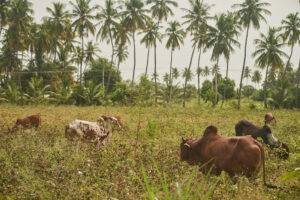
However, I do believe the industry will be forced to take soil more seriously. Climate change, water stress, biodiversity loss and farmer livelihoods are no longer separate from fashion. They are directly connected to the future of materials.
The risk is that regeneration becomes another label or badge without changing the system. The opportunity is that it becomes a real shift in how fashion understands value. If the industry can move from extraction to restoration, then regeneration will not remain a niche idea. It will become the basis of how responsible fashion is made.
This conversation is part of LuxuryNext Conversations, a series exploring the people, materials and ideas shaping the future of sustainable and regenerative fashion.