


If writing about sustainability feels like a repetitive checklist of organic fabrics and agricultural certifications, you are looking at the wrong sectors. True ecological adaptation requires that we audit our entire luxury landscape, moving beyond soft textiles to examine the highly extractive world of fine jewelry.
At the recent Global Fashion Agenda Summit in Copenhagen, the spotlight fell on a massive structural disruption led by Pandora—the Danish jewelry titan founded in 1982—and their ambassador, Pamela Anderson.

Why is a global giant with over four decades of heritage shifting its core strategy? Because consumer expectations have fundamentally changed. Modern luxury is no longer defined by the environmental toll of geological extraction, but by absolute operational transparency. To secure long-term market resilience, Pandora is officially introducing a brand-new metric directly alongside traditional grading systems: The 5th C—Carbon Footprint.
But introducing a new standard is one thing. Maintaining it is another. Will tracking the 5th C actually be sustainable for the global industry?
An industry-wide debate has already begun. The Natural Diamond Council (NDC) recently issued a public pushback against Pandora, labeling the carbon-accounting campaign a misleading marketing stunt. This friction exposes the central challenge of modern material innovation: changing a consumer-facing brand narrative is simple, but re-engineering global corporate supply chains to map forensic carbon data is an operational battlefield.
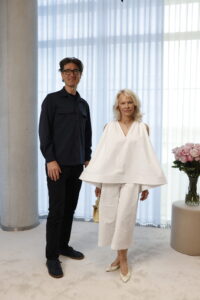
When we look past the industry crossfire, Pandora’s experiment perfectly maps onto our subtle, 3-dimensional methodology for luxury asset innovation.
The Humanity: Re-Engineering the Soul
True innovation requires a complete re-engineering of the romantic narrative. Pamela Anderson challenged the legacy trope that diamonds must be a token of linear extraction and patriarchal gatekeeping. By reframing lab-grown diamonds as an act of self-love, independence, and conscious glamour, the human element of jewelry shifts. The diamond is no longer an exclusionary status symbol; it is an ethical form of personal expression that honors the soul of modern consumer values.
The Biology: Nature as a Stakeholder
Embracing true material substance requires an uncompromised commitment to the planet: Nature isn’t a resource; it’s a stakeholder. By replicating the earth’s natural pressures inside zero-emission laboratories, we honor the physical planet by leaving its deep ecosystems entirely undisturbed. The result is a flawless, identical diamond crystalline structure grown with 100% renewable electricity. We are no longer extracting from the earth; we are co-authoring with physics.
The Infrastructure: Disrupting the System
A beautiful philosophy is useless without the infrastructure to prove it. For a century, the diamond market has relied on the GIA’s traditional 4 Cs (Cut, Carat, Clarity, Color). By publishing audited, per-stone carbon data directly alongside these parameters, Pandora is forcing a new compliance system into the mainstream market. By pairing these stones with 100% recycled silver and gold, they prove that transparent data tracking can drive long-term capital resilience.
The New Benchmark for Fine Jewelry
The disruption is real, and the debate is here. Fine jewelry is no longer just about the rarity of geological extraction. It is about the sophistication of engineering. The brands that survive the next decade will be those that realize sustainability isn’t a marketing layer—it is an operational standard.
All Images Courtesy: Global Fashion Agenda/Global Fashion Summit