
Fashion has become much better at telling us where its materials come from. But as sustainability claims face more scrutiny, knowing the story is no longer enough. Can the industry actually prove it?
A cotton fiber can pass through many hands before it becomes a garment. By then, it can be difficult to verify where it came from, what happened to it along the way, or whether the material is really what it is claimed to be, particularly when recycled content is involved.
This is where Haelixa comes in.
Haelixa is a Swiss deep-tech company and a spin-off of ETH Zürich, a leading Swiss science and technology university. It uses DNA markers to give fibers and other materials an invisible identity that can later be tested and verified.
The company works across materials including cotton, cashmere and recycled fibers, as well as luxury materials and products.
The idea is surprisingly simple: what if the material itself could carry the proof?
We spoke with Haelixa about how DNA-based traceability works, what it can tell us about the materials in our clothes, and why physical proof could become increasingly important as fashion moves towards greater transparency and circularity.
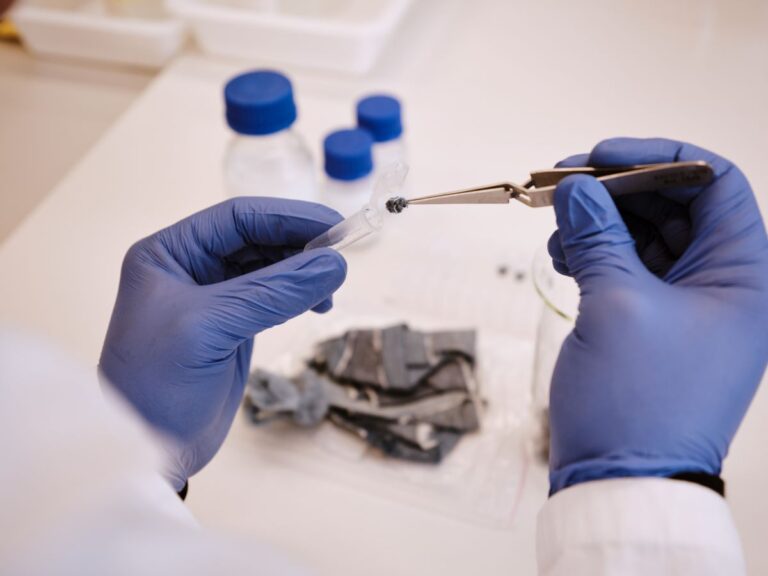
Cashmere testing in Lab, Image courtesy: Haelixa
LuxuryNext: For someone who has never heard of DNA traceability, what is Haelixa’s technology and how does it work?
Haelixa:
Haelixa provides physical, DNA-based verification through two solutions: TraceDNA™ for supply chain traceability and ProofDNA™ for product authentication . Both use our patented DNA – based marker technology to create physical proof directly on a material or product, rather than relying solely on documentation or digital records.
For traceability, we use TraceDNA ™. A unique DNA marker is applied to the material at its source or at another defined point in the supply chain. The material can then be tested at later stages to verify that it is the same material that was originally marked, creating a direct physical link between the material and its claimed origin. The marker is built with natural DNA sequences, is invisible, harmless and designed to be resistant, without affecting the quality of the material. This means the proof travels with the material itself throughout the supply chain. As regulatory frameworks increasingly require brands to provide more reliable product and supply chain information, physical verification can complement the data captured in systems such as Digital Product Passports by providing evidence directly from the material itself.
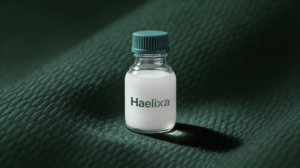
Haelixa DNA bottle, Image courtesy: Haelixa
LuxuryNext: Where is Haelixa’s technology being used in fashion today? What kinds of materials are you working with?
Haelixa:
Haelixa’s technology has proven adoption across textiles, precious metals and gemstones. Within fashion and textiles, the technology can be integrated from raw material sourcing through manufacturing, allowing materials to be physically traced as they move through complex global supply chains. We work across the full supply chain with raw material producers, textile manufacturers, recyclers and brands. This includes organizations such as CottonConnect and OCA on the sourcing side, recyclers and manufacturers like New Focus Textiles and CTCTex, and
digital platforms including TextileGenesis and TrusTrace.
The technology is particularly valuable where brands need to verify claims around origin, recycling, quality or material composition directly on the material itself. These are also areas receiving increasing regulatory attention, as frameworks such as the EU’s Ecodesign for Sustainable Products Regulation (ESPR) and its Digital Product Passport requirements push the industry towards more structured and reliable product information.

Image Courtesy: Haelixa
LuxuryNext: Is DNA tracing mainly about proving where a material comes from, or can it also help brands verify what happens to it along the supply chain?
Haelixa:
It can do both.
Origin is an important use case, but the real value of physical traceability is that verification can take place at different points downstream. Once a material has been marked, it can later be tested to confirm that the expected material is still physically present. This gives brands a way to complement chain-of-custody documentation and digital traceability with physical evidence. Digital systems are extremely useful for recording and sharing information, but they ultimately depend on the data entered into them. DNA provides an additional verification layer directly on the material. That is particularly important in complex supply chains where substitution, mixing or incorrect documentation can occur.
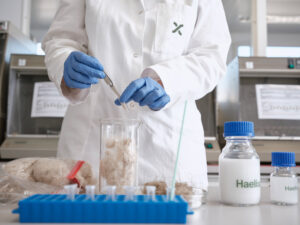
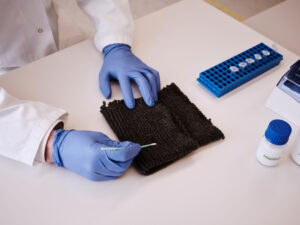
Analyzing nettle in lab, Image Courtesy: Haelixa
LuxuryNext: Can you share some examples of fashion or luxury brands using Haelixa, and what they are using it for?
Haelixa:
For the past 10 years, Haelixa has been working with companies across textile and fashion supply chains, using its DNA – based technology to provide physical verification of materials and support claims related to origin, recycling, quality and material composition.
In one large -scale organic cotton traceability program, Haelixa’s technology has been used to mark 42,000 tons of organic cotton fiber and trace 66 million garments, demonstrating how physical traceability can be implemented at industrial scale from fiber through to finished product. One publicly referenced example is Artwell HK, a vertically integrated premium cashmere supplier working with Haelixa to enable physical traceability across its supply chain.
Haelixa’s DNA markers are applied to cashmere fibers at source, allowing the material to be verified throughout processing and traced from fiber through to the finished garment.
Beyond textiles, Haelixa is also expanding the application of its DNA technology in the luxury sector through ProofDNA™, providing product-level authentication for applications including watches, jewelry and leather goods.
LuxuryNext: What has the technology changed for these companies? What can they know or prove now that was difficult to establish before?
Haelixa:
The biggest change is the shift from relying only on documentation to being able to test the physical material itself.
Traditional traceability systems can tell you what should have happened to a material. With physical DNA traceability, brands gain scientific evidence that helps verify whether the material in front of them corresponds to the material that was originally marked. That strengthens the credibility of claims around origin, recycling, material composition
and quality, while also supporting supply – chain risk management and due diligence. Haelixa can additionally feed verified physical data into digital traceability systems, connecting physical proof with digital records.
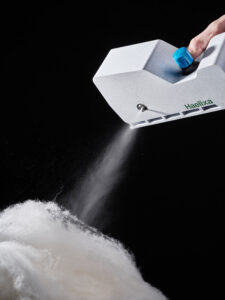
Spraying on cotton, Image Courtesy: Haelixa
LuxuryNext: As fashion moves towards more natural and regenerative materials, where do you see DNA traceability becoming particularly useful?
Haelixa:
The more value a brand places on how and where a material was produced, the more important it becomes to be able to verify that story.
For regenerative and other responsibly sourced materials, brands may be making very specific claims about origin, farming practices, sourcing programs or material composition. These materials can then pass through multiple intermediaries and manufacturing stages before reaching the final product. This is especially relevant for man-made cellulosic fibers, where claims about pulp source and forest origin are difficult to verify once the fiber has been processed.
At the same time, sustainability claims are facing greater scrutiny. As regulation increasingly emphasizes evidence – based environmental claims and supply chain due diligence, being able to connect a claim back to physical material becomes increasingly valuable.
Physical DNA traceability can help preserve the connection between the material and its source throughout that journey. We see it as particularly valuable alongside existing certification, chain-of-custody and digital traceability systems: rather than replacing those systems, DNA adds a physical layer of evidence directly to the material.
LuxuryNext: Could traceability become a competitive advantage for luxury fashion brands?
Haelixa:
Absolutely. Traceability is increasingly moving beyond compliance and becoming part of how brands protect value, build trust and differentiate themselves. For luxury brands in particular, provenance, craftsmanship, material integrity and authenticity are fundamental to the value of the product. Being able to support those claims with physical, scientific evidence gives brands something stronger than a declaration alone.
There is also a second dimension: authentication.
With ProofDNA™, the same principle of physical verification can be applied at product level. An invisible, brand-unique DNA marker can be embedded into a finished product, allowing its authenticity to be independently verified later through a simple swab and forensic test. This can support luxury brands across returns, repairs, resale and other after-sales touchpoints where original documentation may no longer be available. ProofDNA™ can also complement Digital Product Passports, NFC, QR codes and other digital identification systems by adding a physical verification layer to the product itself. This distinction is important: digital systems can record a product’s history, while DNA can provide independent evidence from the physical product.
So, the competitive advantage is ultimately about moving from telling the product story to being able to prove it.