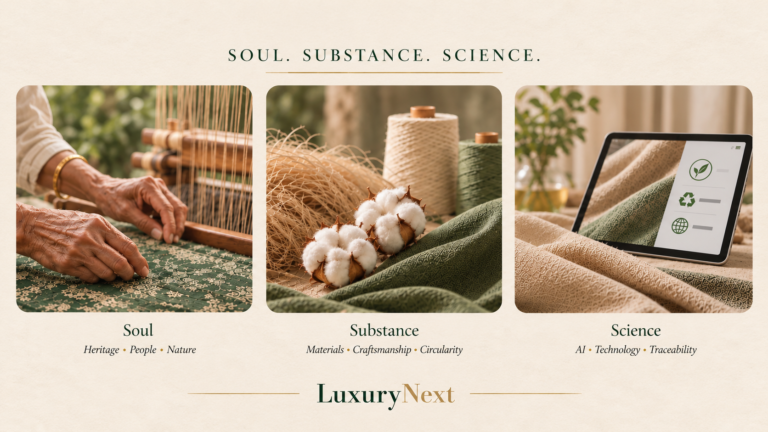
Luxury fashion has always been much more than the product itself. There is a story behind the fabric, the craftsmanship, the people who make it and the materials that go into creating it.
But today, just the story is not enough. As sustainability becomes a bigger part of the fashion and luxury business, brands are being asked to show what actually happens behind the scenes. Where are the materials coming from? Who has made the product and where? Can the origin of a fiber be verified? Most importantly, what do we really know about its environmental impact?
Fashion supply chains can stretch across countries and involve many different suppliers and stages of production, so answering these questions is not easy. Technology is helping brands get a clearer picture of what happens along the way.
Knowing where materials come from
One of the biggest challenges for fashion brands is being able to verify the origin of the materials they use.
Raw material could be sourced from one country, processed in another and turned into fabric somewhere else. By the time it becomes a finished garment, tracing its journey can be difficult.
This is where material verification technologies are beginning to make a difference.
In our conversation with Cornelia Bamert, Founder and CEO of Nettle Circle AG, we explored the company’s work with Himalayan nettle fiber and the importance of being able to verify its origin. Nettle Circle has partnered with Haelixa, which uses DNA-based markers applied to raw material at source. These markers can later be detected in the fiber, yarn or fabric, helping verify where the material originated.
For luxury fashion, where provenance and the quality of materials matter, this offers an additional way to establish trust. It also means that claims about sourcing can be supported by more than documents or a brand’s own statements.
Following a fiber through the supply chain
Verifying the origin of a material is one part of the story. Being able to follow it through the different stages of production is another.
In our interview with Amit Gautam, Founder and CEO of TextileGenesis, we discussed how digital technology is helping fashion and luxury brands trace materials from their source to the finished product.
TextileGenesis connects information from different stages of the textile supply chain, giving brands and suppliers greater visibility into how materials move through production. Its technology is designed to help verify material claims and address issues such as substitution and double counting.
This is particularly relevant as brands work with more regenerative and next-generation fibers. It is one thing to introduce a new material into a collection. It is another to know where it came from and be able to follow its journey through the supply chain.
For brands, this information can support better sourcing decisions. It can also help them provide customers with a clearer picture of the materials behind their products.
Digital Product Passports: What will they tell us?
Digital Product Passports, or DPPs, are another development that fashion brands will need to pay attention to.
In simple terms, a Digital Product Passport is a digital record containing information about a product. Depending on the product category and applicable requirements, it may include details about material composition, origin, durability, repair and environmental characteristics.
For customers, this could mean being able to scan a product and find out more about what it is made of, where it comes from and how to care for it.
For brands, it means having to bring together information about their products and the supply chains behind them.
But a digital passport is only as useful as the information it contains. Brands need reliable data from their suppliers and a better understanding of where their materials come from. This is why traceability is important. It can provide much of the information needed to build a more complete picture of a product.
Where AI fits into fashion
Technology is also changing how fashion businesses use information and make decisions.
In our interview with Charisma Glassman, VP, Global Head of Strategy and AI Transformations, Retail and CPG, we discussed the role of AI in fashion and retail, particularly in areas such as supply-chain visibility, demand planning and sustainability.
Fashion businesses deal with large amounts of information from suppliers, manufacturers and other partners. Making sense of it can be difficult, especially when information is spread across different systems. AI can help businesses analyze this information, identify gaps and make better-informed decisions.
Another important area is demand forecasting. Fashion brands have long struggled to predict what customers will buy, in which sizes and in what quantities. When those decisions are wrong, the result is often excess stock, markdowns and waste.
Better use of data can help brands understand demand more accurately and plan production accordingly. This is not just a commercial consideration. Producing closer to what customers actually need can also help reduce unnecessary production.
As our conversation with Charisma highlighted, the real value of AI lies in how it helps businesses make better decisions. Simply adopting new technology is not enough.
Technology needs to work behind the scenes
There is no doubt that technology is becoming increasingly important to fashion and luxury. From verifying the origin of fibers to following materials through supply chains and improving business decisions, it is changing how brands approach sourcing, production and transparency.
But technology alone cannot solve the industry’s challenges. The information must be accurate, suppliers need to participate and brands must be willing to look beyond their immediate supply chains.
There is also a need to recognize what sits behind every product: the people, skills, materials and natural resources that make it possible.
For luxury fashion, this is particularly important. Craftsmanship and provenance have always been part of its value. Technology now offers ways to understand and verify these elements in greater detail.
The next chapter of fashion and luxury will not be shaped by new materials and design alone. It will also depend on how well brands understand their supply chains, where their materials come from and what goes into making each product.
Technology may not be what customers see when they buy a luxury product. But increasingly, it will help determine what brands can stand behind and what they can prove.