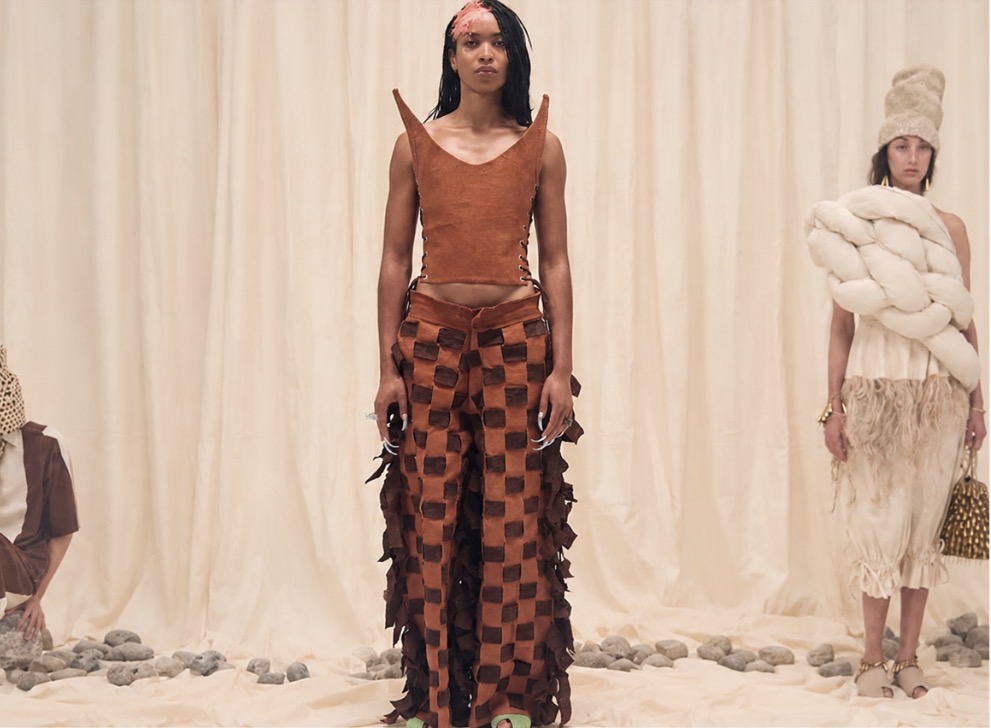

Sustainability in luxury is no longer operating at the margins of the conversation. The fact that Stella McCartney appeared on the cover of TIME magazine’s Earth Awards 2026 coverage is itself telling. It signals that what was once treated as a niche or “values-led” positioning has moved into the center of how luxury fashion is now being discussed, and defined.
McCartney has spent years arguing that fashion can be beautiful without being destructive, and her visibility in mainstream global media reflects something broader: sustainability is no longer a trend layered onto luxury, but part of its core narrative.
But sustainable luxury is no longer just about finding a better fiber or lowering a carbon number.
Look more closely and a broader picture is emerging. Luxury businesses are returning to landscapes, reconsidering the value of biodiversity, experimenting with biological materials, finding new markets for traditional craft and building systems around repair, traceability and the life of a product after it is sold.
Some of these ideas are relatively new. Others have been quietly developing for decades.
What matters now is how they are beginning to connect.
Regeneration
What if a fashion supply chain could help restore the landscape it depends on?
This question is becoming particularly relevant in places where fashion’s raw materials are closely tied to fragile ecosystems.

Image Courtesy: Pexels
In India’s Satpura-Pench landscape, cotton farming sits alongside one of the country’s important wildlife corridors. Through Kering’s Regenerative Fund for Nature, the Wildlife Friendly Enterprise Network, COFE and WWF-India are working with farmers to introduce regenerative farming practices and Wildlife Friendly fiber certification. The project aims to improve soil health and biodiversity while supporting farmer livelihoods and reducing human-wildlife conflict.
Regeneration is not simply about restoring a landscape. It is about making sure the people who live and work within that landscape can remain part of its future.
The cotton is only part of the story. The health of the soil, the surrounding forest, the movement of wildlife and the economic security of farmers are all connected. The value of the project lies in recognizing those connections rather than treating the cotton field as an isolated production unit.
A different version of the same thinking is taking place in Ladakh.
Brunello Cucinelli’s Himalayan Regenerative Fashion Living Lab, developed with the Circular Bioeconomy Alliance and in collaboration with local communities, is working with Changpa pastoralists around cashmere and the restoration of degraded landscapes. The project combines regenerative agriculture, traditional knowledge and local livelihoods, with the first Himalayan cashmere products now being made from the community’s own production.
That combination is important. Regeneration is not simply about restoring a landscape. It is about making sure the people who live and work within that landscape can remain part of its future.
In Mongolia, Kering has taken a similar approach to cashmere, supporting projects focused on healthier rangelands and reducing the pressure of overgrazing while strengthening the resilience of herding communities.
The conversation is therefore moving beyond the question of whether a material is “better” than another. It is asking whether the system that produces the material can become healthier over time.
Biodiversity
Nature is moving from the background of luxury to the center of the conversation.
Some luxury brands have always had a relationship with nature, even when it did not use today’s language of biodiversity and ecosystem restoration. One of the clearest examples is Zegna.
Zegna’s approach came from a much simpler understanding that the wellbeing of the territory, the community and the business were connected.
Long before biodiversity became a corporate sustainability priority, Ermenegildo Zegna understood that the future of his business was connected to the landscape around his wool mill in the Biella Alps.
Beginning in the 1930s, he undertook an extensive reforestation program, eventually planting more than 500,000 trees. The work became Oasi Zegna, a 100-square-kilometre natural territory that remains part of the company’s environmental legacy. What is remarkable is how early the idea appeared. There was no corporate biodiversity framework behind it. Zegna’s approach came from a much simpler understanding that the wellbeing of the territory, the community and the business were connected.
Image Courtesy: Pexels
That idea now has a much more formal place in luxury. Kering’s biodiversity strategy, for example, looks at the relationship between its businesses and ecosystems through a hierarchy of avoiding, reducing, restoring and regenerating impacts, with transformation as the longer-term ambition.
This matters because biodiversity is not an abstract environmental issue for a sector that works with natural fibers, animal materials and agricultural products. A degraded ecosystem can eventually affect the availability, quality and cost of the materials on which luxury depends.
The question for brands is therefore becoming more practical: what natural systems sit behind our materials, and what are we doing to keep them healthy?
Materials
The next interesting luxury material may come from somewhere fashion has not traditionally looked.
The search for better materials has become one of the most visible parts of fashion’s sustainability story.
But the most interesting developments are not limited to replacing one conventional fiber with another. Researchers and designers are looking at mycelium, seaweed, agricultural residues, plant-based materials and biological resources. Increasingly, innovation is also coming from places where the material is closely connected to local ecology and knowledge.
Image Courtesy: Brett Sayles via Pexels
Brazil is an interesting example. Designers and material researchers are exploring resources from native plants and other biological sources, bringing fashion and material science closer to the country’s extraordinary biodiversity.
Colombia offers another perspective. Designer David Cabra has worked with materials incorporating red clay and natural pigments, while collaborations with Brazilian designers have explored biotextiles using materials such as wood powders and natural pigments.
These projects are interesting not because every experiment will become a commercial luxury material. They show that material innovation is becoming more geographically diverse and more closely connected to place.
India’s Eri silk tells a different part of the same story. Traditionally associated with northeastern India, Eri is finding new relevance through contemporary designers and brands. Jamini, founded by Usha Bora, works with artisans in Assam and has brought Eri silk into contemporary collections and international fashion contexts. The material is not being presented simply as a heritage object. It is being given a new place in contemporary design.
That distinction matters. The opportunity is not simply to discover another “sustainable material”, but to build value around where a material comes from, how it is made and the knowledge that surrounds it.
Craft
Craft is moving from the workshop into the spotlight.
Luxury has always depended on skilled hands, but for much of its history, the people and processes behind the finished object remained largely invisible. The product mattered; the making stayed in the background.
That is beginning to change. Eri silk is a good example of how an old craft can find a new audience. Traditionally associated with Assam and the Northeast, Eri is being brought into contemporary fashion by designers and brands working with regional artisans. Designers such as Sonam Dubal have used it to connect traditional textile knowledge with a modern design language, while labels like Jamini have taken Eri silk into international fashion contexts.
What was once a regional heritage textile is now part of a wider conversation about contemporary luxury.
At the other end of the spectrum, Hermès is bringing its craft heritage out from behind the scenes. Its Hermès in the Making exhibition, which travelled to Shanghai in May 2026, brought artisans from different métiers into direct contact with the public, showing the skill and time behind leather, silk, porcelain, jewelry and watchmaking.
This is significant beyond the exhibition itself as the craftsperson is becoming part of the brand story.
Instead of showing only the finished object, luxury is increasingly revealing the hands, techniques and knowledge behind it. Craft is becoming a tool to communicate authenticity, longevity and value, rather than something hidden in production.
At the same time, this shift changes the position of the artisan. By bringing craft into the public narrative of luxury, artisans gain visibility, recognition, and a stronger sense of authorship over their work.
Systems
Some of the biggest changes in fashion are happening long after a product leaves the runway.
The sustainability conversation has spent years focusing on how a product is made. Increasingly, attention is moving to what happens afterwards.
Repair is becoming a business model
Repair is moving beyond the traditional tailor or customer-service desk and becoming a structured part of the relationship between brands and customers.
United Repair Centre is one example. Its model combines skilled repair with technology and aftercare services, allowing brands to manage repairs at scale while gathering information about their products. It now works with more than 30 brand partners and opened its Paris hub in 2026, following locations in Amsterdam and London.
What makes the model particularly interesting is the information generated through repair. Understanding which parts of a product fail, what customers choose to repair and how products behave over time can feed back into product development. Repair therefore becomes more than extending the life of a garment. It can become a source of intelligence about the product itself.
Knowing where a material came from
As supply chains become more complex and regulation becomes more demanding, brands need to do more than tell customers where a material supposedly comes from. They increasingly need ways to verify it.
Provenance is moving towards something that can be checked rather than simply claimed.
DNA-based traceability is one technology being explored for this purpose. By introducing a physical marker that can later be tested, it offers a potential way to verify the provenance of materials as they move through a supply chain. The technology is still developing, but the underlying idea is important. Provenance is moving towards something that can be checked rather than simply claimed.
The product passport is becoming part of the product
Europe’s Digital Product Passport framework points towards another change: more information travelling with the product itself. Material composition, sourcing, care, repair and end-of-life information can increasingly become part of the product record, rather than information sitting separately inside a sustainability report.
That has implications for recycling too.
Textile recycling is becoming more sophisticated, but recycling works better when the materials in a garment can be identified and separated properly. If a recycler knows what a product contains, where the different materials are used and how they have been constructed, the chances of keeping those materials in circulation improve.
The result could eventually be a much clearer journey from production to use, repair, resale, recycling and end of life.
This is where sustainability starts to become infrastructure rather than communication.
The Bigger Picture
The five directions are closely connected. A regenerative cotton project can improve soil while protecting biodiversity and supporting farmers. A new material can draw on local biological resources and create new opportunities for designers. A traditional textile can reach a new market while keeping knowledge and livelihoods alive. Repair can extend a product’s life and generate information that improves future design. Traceability and product passports can make it easier to understand what a product contains and where it goes next.
None of these developments, on their own, will transform fashion. But together, they point towards a different idea of what sustainable luxury could become. It is less about finding one perfect material or one universal solution, and more about understanding the relationships between nature, people, materials and the businesses built around them. That may be the more interesting definition of progress.
Luxury is no longer defined only by what we create, but increasingly by what we leave behind.