
As we celebrate the Art de Vivre à la française in New Delhi this month, we aren’t just looking at French design; we are witnessing a 400-year-old dialogue reach its creative zenith. From the 17th-century palaces of Versailles to the 2026 runways of Paris, the bond between India and France is the world’s most enduring luxury alliance.
Way back in 17th century, during the reign of Louis XIV, the desire for Indian “Chintz” and “Calicos” in France led to them being banned to protect the local mills. Both these fabrics stem from India’s ancient textile traditions, with trade peaking in the 17th-18th centuries. Chintz fabrics were known for their glazed, glossy surface and Calico was named after the port of Calicut and this was a plain, woven and usually white fabric.
French luxury was reinvented by the Maharajas of Patiala and Kapurthala, who transformed French high jewelry. By bringing their family gemstonesto Cartier and Boucheron, they didn’t just give them business; they co-created the Tutti Frutti aesthetic and introduced Indian gemstone-carving to the Place Vendôme.
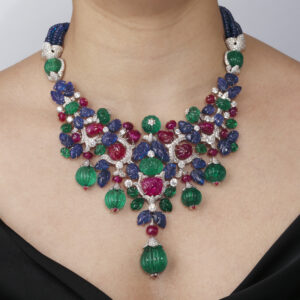
Tutti-Frutti Necklace, Cartier
Image Courtesy: Christies
The recent opening of Galeries Lafayette Mumbai with ABFRL is a new partership. This isn’t just a store; it’s a a bridge where French brands find new meaning in the vibrant energy of the Indian consumer. India is now among the top three fastest-growing luxury markets. The collaboration is no longer just about making beautiful things—it’s about Global Market Sovereignty.
Just yesterday (Feb 18), Isha Ambani wore a saree-inspired Chanel Haute Couture gown in Delhi—closing the 100-year loop from Coco to the contemporary Indian fashion.
The Current Pulse: Art de Vivre à la française (2026)
This week at India Design ID, the French Pavilion (presented by Business France and the French Embassy) showcases 16 legendary Houses. But look closer at the names: Baccarat, Assouline, and Galeries Lafayette (now anchored in India via ABFRL). These aren’t just “imports.” They represent a shared language.
On Thursday, February 19th, the Indo-French Design Dialogues will bring together voices like Vikram Goyaland India Mahdavi. They are there to discuss the “Age of Syncretism”—the idea that modern luxury is a hybrid.
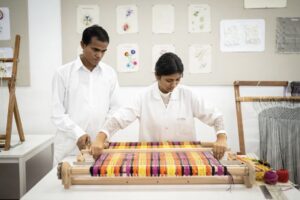
Image Courtesy: Chanakya School of Craft
The “Hidden” Heritage: Lesage and the Karigar
We must acknowledge the Vastrakala atelier in Chennai and the Chanakya School in Mumbai. For decades, the intricate beadwork on a Chanel jacket or the embroidery on a Dior couture gown has been the silent work of Indian hands. French Maisons are now publicly celebrating Indian savoir-faire as an equal partner. This is the Sovereign Shift: the transition from being a “supplier” to being a Co-Author.
The 2026 Innovation Year isn’t just about technology and AI; it’s also about the Innovation of Heritage. As the doors to India Design ID open this Thursday, we aren’t just looking at furniture or fashion, we are looking at a centuries old bridge thas has survived revolutions and recessions. History tells us that India was never just a market for France. We were the muse, the engineer, and the master-craftsman. As we look at the Circular Design Challenge or the Art de Vivre pavilion today, we aren’t starting a new chapter. We are simply reclaiming the pen in a 400-year-old book of excellence.
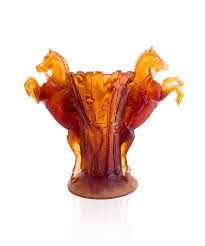
Image Courtesy: Daum


- Aekta Kapoor (2)
- Aleyssandra Mendosa (1)
- Anuj Puri (3)
- Arvind Vijaymohan (1)
- Ashok Som (5)
- Ashutosh Limaye (1)
- Deepali Nandwani (19)
- Eva Pavithran (1)
- Gargi Guha (4)
- Gina Mathew (1)
- Ishanee Patra (1)
- Jenifer Willig (1)
- Joanne Pereira (4)
- Jordan Phillips (1)
- Kishor Pate (1)
- L.Aruna Dhir (4)
- Lauren Mote (1)
- LuxuryNext Team (205)
- Megha Puri (10)
- Mitch Ritter (3)
- Nishant Bangar (3)
- Nolan Lewis (17)
- Radhika Singh (1)
- Sanjana Chauhan (68)
- Shibani Dasgupta (1)
- Soumya Jain (3)
- Sue Stephenson (1)
- TheLuxury NextTeam (17)
- Veronique Poles (1)