

Image Courtesy: Zurich Airport
For decades, the airport was a place of transition—a “non-place” designed to be moved through as quickly as possible. But as I look at the shifting landscapes of global luxury, from the sleek terracotta of The Circle in Zurich to the ambitious blueprint of Bharti Aerocity, it is clear that the airport has become the destination itself. With numerous shopping opportunities, various restaurants, and two Hyatt hotels, The Circle is an exciting meeting place for people from near and far.
Designed by Japanese architect Riken Yamamoto, The Circle isn’t just a glass building. It was inspired by Zurich’s Niederdorf (the historic Old Town). Yamamoto designed it as a “Micro-City” with narrow, winding alleys and public squares. Unlike a standard mall with massive atriums, The Circle feels like a high-street. It uses a “Closed Cavity Façade” (CCF)—high-tech glass that provides perfect acoustic insulation from the roaring jet engines outside while flooding the interior with natural light.
The 9th City of Delhi
History tells us Delhi is a city of seven lives—from the Rajput walls of Qila Rai Pithora to the Mughal splendor of Shahjahanabad. Some say eight, counting the stately avenues of Lutyens’ New Delhi. But as I stand in the Gateway District today, I am convinced we are building the 9th City.
The PLP Vision: A New Urban Grammar
“While the concept of the Aerotropolis belongs to the world, the soul of this project is deeply rooted in Delhi’s DNA. This is why London-based PLP Architecture—the visionaries behind the master plan—has officially dubbed Aerocity ‘The 9th City of Delhi.’ By referencing the historic city-states of Delhi’s past, PLP has moved away from the ‘Enclosed Mall’ model. Instead, they’ve introduced an ‘Inside-Out’ Urbanism. For the 2.8 million sq. ft. Worldmall, this means permeable facades, double-height luxury volumes, and a public realm that feels like a modern high-street in Paris or Zurich, but built to the scale of the Indian future.”
The Aerotropolis Vision: From DeSantis to 2026
The concept of the Aerotropolis, a city built around an airport, was first envisioned as a futuristic sketch by Nicholas DeSantis in 1939 and later codified by Dr. John Kasarda. They predicted that in the 21st century, the airport would replace the seaport and the railway as the engine of urban growth.
To understand the potential of the 9th City, we must look at the “Global Triplets” that have already mastered the Aerotropolis model. Each offers a specific lesson for Delhi’s evolution.
Dubai World Central (DWC) taught us that an Aerotropolis is not an “add-on” to a city; it is an independent economic engine. Just as Dubai offers a seamless, high-security environment for global HNIs, Delhi’s 9th City will be a “Safe Harbor” where world-class standards are guaranteed, regardless of the chaos beyond its perimeter.
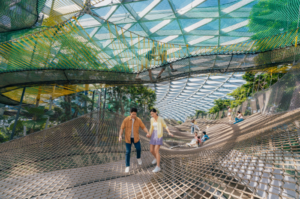
Image Courtesy: Jewel Changi Airport
Jewel Changi in Singapore has proved that a “landside” airport destination can become a primary weekend spot for locals, not just travelers. By integrating biophilic design and massive public attractions (like their indoor waterfall), Singapore turned an airport into a “Community Anchor.”
Aeroville at Charles de Gaulle replaced the “airport box” with a permeable, high-street shopping experienc. PLP Architecture’s “Inside-Out” design for Aerocity mirrors this Parisian approach. It’s about urban permeability —creating streets that breathe, double-height flagship stores, and an environment that feels like a European promenade rather than a traditional shopping center.
The Frictionless Future
Finally, as observed across the global luxury landscape, wealth always flows toward Frictionless Access.
With the Regional Rapid Transit System (RRTS) and the Golden Line Metro connecting South Delhi to Aerocity by 2026-27, we are removing the friction of the city. A family from Gurugram or a business head from Paris can now step into a “Safe Harbor” environment, one that offers IGBC-certified air quality, 24/7 security, and world-class retail volumes that the congested city center simply cannot provide.
The move toward the Aerotropolis is not a trend; it is a flight to quality. We are anchoring India’s place in the global luxury network.
Delhi has always been a city of empires. It’s future empire is this new ecosystem.
Image Courtesy: Zuerich.com


- Aekta Kapoor (2)
- Aleyssandra Mendosa (1)
- Anuj Puri (3)
- Arvind Vijaymohan (1)
- Ashok Som (5)
- Ashutosh Limaye (1)
- Deepali Nandwani (19)
- Eva Pavithran (1)
- Gargi Guha (4)
- Gina Mathew (1)
- Ishanee Patra (1)
- Jenifer Willig (1)
- Joanne Pereira (4)
- Jordan Phillips (1)
- Kishor Pate (1)
- L.Aruna Dhir (4)
- Lauren Mote (1)
- LuxuryNext Team (205)
- Megha Puri (10)
- Mitch Ritter (3)
- Nishant Bangar (3)
- Nolan Lewis (17)
- Radhika Singh (1)
- Sanjana Chauhan (69)
- Shibani Dasgupta (1)
- Soumya Jain (3)
- Sue Stephenson (1)
- TheLuxury NextTeam (17)
- Veronique Poles (1)